At a time when most Americans were
uninformed, misinformed, or simply afraid of Islam, Thomas Jefferson
imagined Muslims as future citizens of his new nation. His engagement
with the faith began with the purchase of a Qur’an eleven years before
he wrote the Declaration of Independence. Jefferson’s Qur’an survives
still in the Library of Congress, serving as a symbol of his and early
America’s complex relationship with Islam and its adherents. That
relationship remains of signal importance to this day.
That he
owned a Qur’an reveals Jefferson’s interest in the Islamic religion, but
it does not explain his support for the rights of Muslims. Jefferson
first read about Muslim “civil rights” in the work of one of his
intellectual heroes: the seventeenth-century English philosopher John
Locke. Locke had advocated the toleration of Muslims—and Jews—following
in the footsteps of a few others in Europe who had considered the matter
for more than a century before him. Jefferson’s ideas about Muslim
rights must be understood within this older context, a complex set of
transatlantic ideas that would continue to evolve most markedly from the
sixteenth through the nineteenth centuries.
Amid the
interdenominational Christian violence in Europe, some Christians,
beginning in the sixteenth century, chose Muslims as the test case for
the demarcation of the theoretical boundaries of their toleration for
all believers. Because of these European precedents, Muslims also became
a part of American debates about religion and the limits of
citizenship. As they set about creating a new government in the United
States, the American Founders, Protestants all, frequently referred to
the adherents of Islam as they contemplated the proper scope of
religious freedom and individual rights among the nation’s present and
potential inhabitants. The founding generation debated whether the
United States should be exclusively Protestant or a religiously plural
polity. And if the latter, whether political equality—the full rights of
citizenship, including access to the highest office—should extend to
non-Protestants. The mention, then, of Muslims as potential citizens of
the United States forced the Protestant majority to imagine the
parameters of their new society beyond toleration. It obliged them to
interrogate the nature of religious freedom: the issue of a “religious
test” in the Constitution, like the ones that would exist at the state
level into the nineteenth century; the question of “an establishment of
religion,” potentially of Protestant Christianity; and the meaning and
extent of a separation of religion from government.
Resistance
to the idea of Muslim citizenship was predictable in the eighteenth
century. Americans had inherited from Europe almost a millennium of
negative distortions of the faith’s theological and political character.
Given the dominance and popularity of these anti-Islamic
representations, it was startling that a few notable Americans not only
refused to exclude Muslims, but even imagined a day when they would be
citizens of the United States, with full and equal rights. This
surprising, uniquely American egalitarian defense of Muslim rights was
the logical extension of European precedents already mentioned. Still,
on both sides of the Atlantic, such ideas were marginal at best. How,
then, did the idea of the Muslim as a citizen with rights survive
despite powerful opposition from the outset? And what is the fate of
that ideal in the twenty-first century?
This book provides a new
history of the founding era, one that explains how and why Thomas
Jefferson and a handful of others adopted and then moved beyond European
ideas about the toleration of Muslims. It should be said at the outset
that these exceptional men were not motivated by any inherent
appreciation for Islam as a religion. Muslims, for most American
Protestants, remained beyond the outer limit of those possessing
acceptable beliefs, but they nevertheless became emblems of two
competing conceptions of the nation’s identity: one essentially
preserving the Protestant status quo, and the other fully realizing the
pluralism implied in the Revolutionary rhetoric of inalienable and
universal rights. Thus while some fought to exclude a group whose
inclusion they feared would ultimately portend the undoing of the
nation’s Protestant character, a pivotal minority, also Protestant,
perceiving the ultimate benefit and justice of a religiously plural
America, set about defending the rights of future Muslim citizens.
They
did so, however, not for the sake of actual Muslims, because none were
known at the time to live in America. Instead, Jefferson and others
defended Muslim rights for the sake of “imagined Muslims,” the promotion
of whose theoretical citizenship would prove the true universality of
American rights. Indeed, this defense of imagined Muslims would also
create political room to consider the rights of other despised
minorities whose numbers in America, though small, were quite real,
namely Jews and Catholics. Although it was Muslims who embodied the
ideal of inclusion, Jews and Catholics were often linked to them in
early American debates, as Jefferson and others fought for the rights of
all non-Protestants.
In 1783, the year of the nation’s official
independence from Great Britain, George Washington wrote to recent Irish
Catholic immigrants in New York City. The American Catholic minority of
roughly twenty-five thousand then had few legal protections in any
state and, because of their faith, no right to hold political office in
New York. Washington insisted that “the bosom of America” was “open to
receive . . . the oppressed and the persecuted of all Nations and
Religions; whom we shall welcome to a participation of all our rights
and privileges.” He would also write similar missives to Jewish
communities, whose total population numbered only about two thousand at
this time.
One year later, in 1784, Washington theoretically
enfolded Muslims into his private world at Mount Vernon. In a letter to a
friend seeking a carpenter and bricklayer to help at his Virginia home,
he explained that the workers’ beliefs—or lack thereof—mattered not at
all: “If they are good workmen, they may be of Asia, Africa, or Europe.
They may be Mahometans [Muslims], Jews or Christian of an[y] Sect, or
they may be Atheists.” Clearly, Muslims were part of Washington’s
understanding of religious pluralism—at least in theory. But he would
not have actually expected any Muslim applicants.
Although we have
since learned that there were in fact Muslims resident in
eighteenth-century America, this book demonstrates that the Founders and
their generational peers never knew it. Thus their Muslim constituency
remained an imagined, future one. But the fact that both Washington and
Jefferson attached to it such symbolic significance is not accidental.
Both men were heir to the same pair of opposing European traditions.
The
first, which predominated, depicted Islam as the antithesis of the
“true faith” of Protestant Christianity, as well as the source of
tyrannical governments abroad. To tolerate Muslims—to accept them as
part of a majority Protestant Christian society—was to welcome people
who professed a faith most eighteenth-century Europeans and Americans
believed false, foreign, and threatening. Catholics would be similarly
characterized in American Protestant founding discourse. Indeed, their
faith, like Islam, would be deemed a source of tyranny and thus
antithetical to American ideas of liberty.
In order to counter
such fears, Jefferson and other supporters of non-Protestant citizenship
drew upon a second, less popular but crucial stream of European
thought, one that posited the toleration of Muslims as well as Jews and
Catholics. Those few Europeans, both Catholic and Protestant, who first
espoused such ideas in the sixteenth century often died for them. In the
seventeenth century, those who advocated universal religious toleration
frequently suffered death or imprisonment, banishment or exile, the
elites and common folk alike. The ranks of these so-called heretics in
Europe included Catholic and Protestant peasants, Protestant scholars of
religion and political theory, and fervid Protestant dissenters, such
as the first English Baptists—but no people of political power or
prominence. Despite not being organized, this minority consistently
opposed their coreligionists by defending theoretical Muslims from
persecution in Christian-majority states.
As a member of the
eighteenth-century Anglican establishment and a prominent political
leader in Virginia, Jefferson represented a different sort of proponent
for ideas that had long been the hallmark of dissident victims of
persecution and exile. Because of his elite status, his own endorsement
of Muslim citizenship demanded serious consideration in Virginia—and the
new nation. Together with a handful of like-minded American
Protestants, he advanced a new, previously unthinkable national
blueprint. Thus did ideas long on the fringe of European thought flow
into the mainstream of American political discourse at its inception.
Not
that these ideas found universal welcome. Even a man of Jefferson’s
national reputation would be attacked by his political opponents for his
insistence that the rights of all believers should be protected from
government interference and persecution. But he drew support from a
broad range of constituencies, including Anglicans (or Episcopalians),
as well as dissenting Presbyterians and Baptists, who suffered
persecution perpetrated by fellow Protestants. No denomination had a
unanimously positive view of non-Protestants as full American citizens,
yet support for Muslim rights was expressed by some members of each.
What
the supporters of Muslim rights were proposing was extraordinary even
at a purely theoretical level in the eighteenth century. American
citizenship—which had embraced only free, white, male Protestants—was in
effect to be abstracted from religion. Race and gender would continue
as barriers, but not so faith. Legislation in Virginia would be just the
beginning, the First Amendment far from the end of the story; in fact,
Jefferson, Washington, and James Madison would work toward this ideal of
separation throughout their entire political lives, ultimately leaving
it to others to carry on and finish the job. This book documents, for
the first time, how Jefferson and others, despite their negative, often
incorrect understandings of Islam, pursued that ideal by advocating the
rights of Muslims and all non-Protestants.
A decade before George
Washington signaled openness to Muslim laborers in 1784 he had listed
two slave women from West Africa among his taxable property. “Fatimer”
and “Little Fatimer” were a mother and daughter—both indubitably named
after the Prophet Muhammad’s daughter Fatima (d. 632). Washington
advocated Muslim rights, never realizing that as a slaveholder he was
denying Muslims in his own midst any rights at all, including the right
to practice their faith. This tragic irony may well have also recurred
on the plantations of Jefferson and Madison, although proof of their
slaves’ religion remains less than definitive. Nevertheless, having been
seized and transported from West Africa, the first American Muslims may
have numbered in the tens of thousands, a population certainly greater
than the resident Jews and possibly even the Catholics. Although some
have speculated that a few former Muslim slaves may have served in the
Continental Army, there is little direct evidence any practiced Islam
and none that these individuals were known to the Founders. In any case,
they had no influence on later political debates about Muslim
citizenship.
The insuperable facts of race and slavery rendered
invisible the very believers whose freedoms men like Jefferson,
Washington, and Madison defended, and whose ancestors had resided in
America since the seventeenth century, as long as Protestants had.
Indeed, when the Founders imagined future Muslim citizens, they
presumably imagined them as white, because by the 1790s “full American
citizenship could be claimed by any free, white immigrant, regardless of
ethnicity or religious beliefs.”
The two actual Muslims Jefferson
would wittingly meet during his lifetime were not black West African
slaves but North African ambassadors of Turkish descent. They may have
appeared to him to have more melanin than he did, but he never commented
on their complexions or race. (Other observers either failed to mention
it or simply affirmed that the ambassador in question was not black.)
But then Jefferson was interested in neither diplomat for reasons of
religion or race; he engaged them because of their political power.
(They were, of course, also free.)
But even earlier in his
political life—as an ambassador, secretary of state, and vice
president—Jefferson had never perceived a predominantly religious
dimension to the conflict with North African Muslim powers, whose
pirates threatened American shipping in the Mediterranean and eastern
Atlantic. As this book demonstrates, Jefferson as president would insist
to the rulers of Tripoli and Tunis that his nation harbored no
anti-Islamic bias, even going so far as to express the extraordinary
claim of believing in the same God as those men.
The equality of
believers that Jefferson sought at home was the same one he professed
abroad, in both contexts attempting to divorce religion from politics,
or so it seemed. In fact, Jefferson’s limited but unique appreciation
for Islam appears as a minor but active element in his presidential
foreign policy with North Africa—and his most personal Deist and
Unitarian beliefs. The two were quite possibly entwined, with their
source Jefferson’s unsophisticated yet effective understanding of the
Qur’an he owned.
Still, as a man of his time, Jefferson was not
immune to negative feelings about Islam. He would even use some of the
most popular anti-Islamic images inherited from Europe to drive his
early political arguments about the separation of religion from
government in Virginia. Yet ultimately Jefferson and others not as well
known were still able to divorce the idea of Muslim citizenship from
their dislike of Islam, as they forged an “imagined political
community,” inclusive beyond all precedent.
The clash between
principle and prejudice that Jefferson himself overcame in the
eighteenth and nineteenth centuries remains a test for the nation in the
twenty-first. Since the late nineteenth century, the United States has
in fact become home to a diverse and dynamic American Muslim citizenry,
but this population has never been fully welcomed. Whereas in
Jefferson’s time organized prejudice against Muslims was exercised
against an exclusively foreign and imaginary nonresident population,
today political attacks target real, resident American Muslim citizens.
Particularly in the wake of 9/11 and the so-called War on Terror, a
public discourse of anti-Muslim bigotry has arisen to justify depriving
American Muslim citizens of the full and equal exercise of their civil
rights.
For example, recent anti-Islamic slurs used to deny the
legitimacy of a presidential candidacy contained eerie echoes of
founding precedents. The legal possibility of a Muslim president was
first discussed with vitriol during debates involving America’s
Founders. Thomas Jefferson would be the first in the history of American
politics to suffer the false charge of being a Muslim, an accusation
considered the ultimate Protestant slur in the eighteenth century. That a
presidential candidate in the twenty-first century should have been
subject to much the same false attack, still presumed as politically
damning to any real American Muslim candidate’s potential for elected
office, demonstrates the importance of examining how the multiple images
of Islam and Muslims first entered American consciousness and how the
rights of Muslims first came to be accepted as national ideals.
Ultimately, the status of Muslim citizenship in America today cannot be
properly appreciated without establishing the historical context of its
eighteenth-century origins.
Muslim American rights became a
theoretical reality early on, but as a practical one they have been much
slower to evolve. In fact, they are being tested daily. Recently, John
Esposito, a distinguished historian of Islam in contemporary America,
observed, “Muslims are led to wonder: What are the limits of this
Western pluralism?” Thomas Jefferson’s Qur’an documents the origins of
such pluralism in the United States in order to illuminate where, when,
and how Muslims were first included in American ideals.
Until now,
most historians have proposed that Muslims represented nothing more
than the incarnated antithesis of American values. These same voices
also insist that Protestant Americans always and uniformly defined both
the religion of Islam and its practitioners as inherently un-American.
Indeed, most historians posit that the emergence of the United States as
an ideological and political phenomenon occurred in opposition to
eighteenth-century concepts about Islam as a false religion and source
of despotic government. There is certainly evidence for these
assumptions in early American religious polemic, domestic politics,
foreign policy, and literary sources. There are, however, also
considerable observations about Islam and Muslims that cast both in a
more affirmative light, including key references to Muslims as future
American citizens in important founding debates about rights. These
sources show that American Protestants did not monolithically view Islam
as “a thoroughly foreign religion.”
This book documents the
counterassertion that Muslims, far from being definitively un-American,
were deeply embedded in the concept of citizenship in the United States
since the country’s inception, even if these inclusive ideas were not
then accepted by the majority of Americans. While focusing on
Jefferson’s views of Islam, Muslims, and the Islamic world, it also
analyzes the perspectives of John Adams and James Madison. Nor is it
limited to these key Founders. The cast of those who took part in the
contest concerning the rights of Muslims, imagined and real, is not
confined to famous political elites but includes Presbyterian and
Baptist protestors against Virginia’s religious establishment; the
Anglican lawyers James Iredell and Samuel Johnston in North Carolina,
who argued for the rights of Muslims in their state’s constitutional
ratifying convention; and John Leland, an evangelical Baptist preacher
and ally of Jefferson and Madison in Virginia, who agitated in
Connecticut and Massachusetts in support of Muslim equality, the
Constitution, the First Amendment, and the end of established religion
at the state level.
The lives of two American Muslim slaves of
West African origin, Ibrahima Abd al-Rahman and Omar ibn Said, also
intersect this narrative. Both were literate in Arabic, the latter
writing his autobiography in that language. They remind us of the
presence of tens of thousands of Muslim slaves who had no rights, no
voice, and no hope of American citizenship in the midst of these early
discussions about religious and political equality for future, free
practitioners of Islam.
Imagined Muslims, along with real Jews and
Catholics, were the consummate outsiders in much of America’s political
discourse at the founding. Jews and Catholics would struggle into the
twentieth century to gain in practice the equal rights assured them in
theory, although even this process would not entirely eradicate
prejudice against either group. Nevertheless, from among the original
triad of religious outsiders in the United States, only Muslims remain
the objects of a substantial civic discourse of derision and
marginalization, still being perceived in many quarters as not fully
American. This book writes Muslims back into our founding narrative in
the hope of clarifying the importance of critical historical precedents
at a time when the idea of the Muslim as citizen is, once more, hotly
contested.
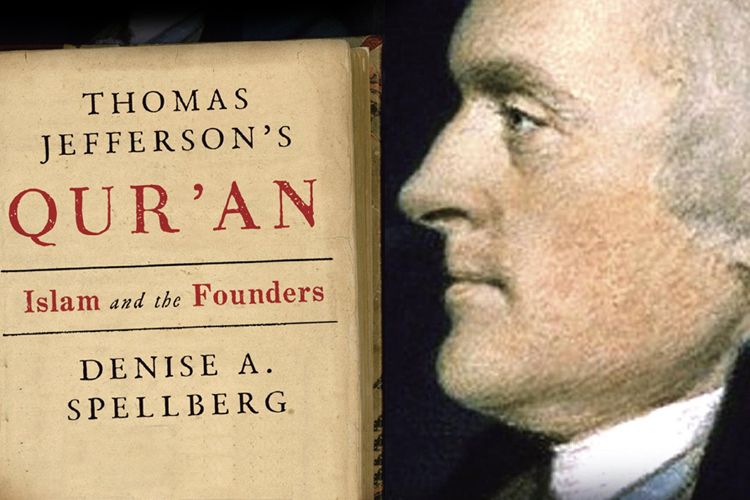
Excerpted from “Thomas Jefferson’s Qur’an” by
Denise A. Spellberg. Copyright © 2013 by Denise A. Spellberg. Excerpted
by permission of Knopf, a division of Random House LLC. All rights
reserved. No part of this excerpt may be reproduced or reprinted without
permission in writing from the publisher.