The post-
Citizens United dark money showdown is underway in Wisconsin.
Wisconsin makes sense. In November 2010, Wisconsin Governor Scott
Walker swept to power at a time of economic turmoil with a promise to
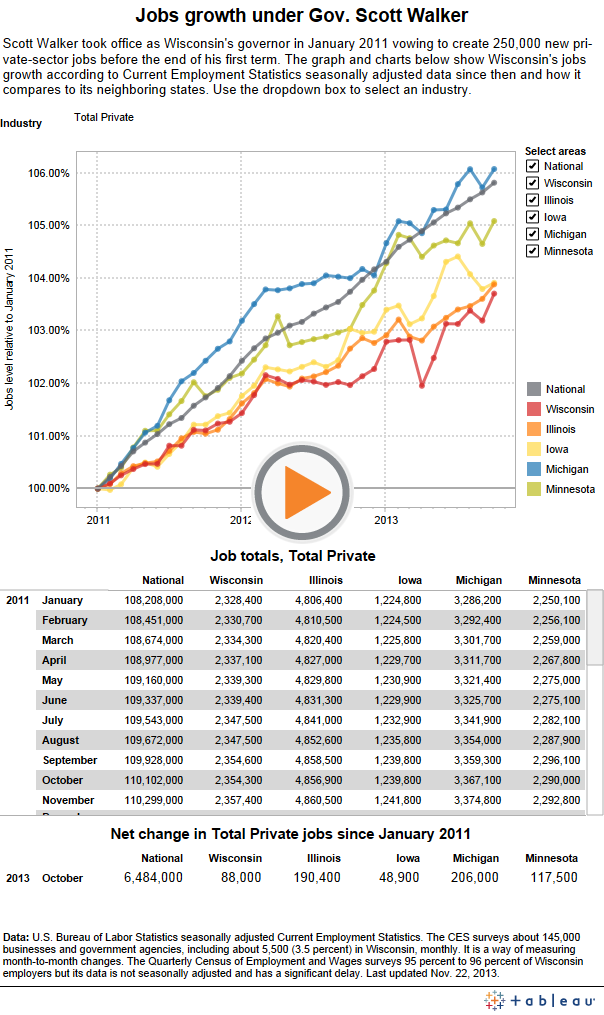
create 250,000 jobs. Instead, with Republican control of both houses, he
passed a bill knee-capping public-sector unions, sparking an 18-day
occupation of the Capitol and weeks of mass protests, regularly topping
100,000.
The controversy immediately kicked off a struggle for control of the
Wisconsin Senate. Between 2011 and 2012 Wisconsin voters across the
state knocked on doors, circulated recall petitions, and put an
unprecedented number of state officials up for recall. Thirteen state
senators eventually faced recall elections. Close to one million people
signed recall petitions for the Governor and Lt. Governor, and even
before an election was certified, outside money began to saturate the
state.
$137.5 million is estimated to have been spent on the recalls in total, the vast majority from out-of-state players.
The source of much of that spending remains unknown. Millions were
spent in by "dark money" nonprofits -- most of them organized under
501(c)(4) of the tax code -- that allow deep pocketed donors to hide
their identity. These groups spent boatloads, but attempted to evaded
state disclosure laws by running phony issue ads that do not expressly
advocate for the election or defeat of a candidate. These nonprofits are
supposed to be social welfare groups, and cannot exist for the "primary
purpose" of participating in political activity. Many have interpreted
this to mean that no more than 49 percent of their funds can be spent on
"issue" advertising.
Dozens of 501(c)(4)s spent huge sums in defense of Team Walker. Not
only did they not disclose their donors, they engaged in a dizzying
array of fund transfers, spelled out by my colleague
Brendan Fischer at the Center for Media and Democracy/PRWatch, perhaps in an effort to stay under the 49 percent line.
These groups played big in the election along with Walker's own
campaign committee and the Republican Governors Association, which
dropped
$9 million on
what are called "independent expenditures." Independent expenditure
groups are required to register with the state and swear an oath not to
coordinate with candidates under Wisconsin law
11.06 (7).
As the funds flooded the state, no one was checking to see if the
diversity of groups were playing by the rules. But now someone may be
doing just that. In the past few months, a special prosecutor with
Republican credentials has issued dozens of subpoenas reportedly related
to the recall spending. Because of Wisconsin's unusual "John Doe"
statute and its secrecy rules, little is known about the grounds of the
investigation, although some reports say prosecutors are looking at
illegal coordination between candidates and purportedly "independent"
groups.
News Breaks of Criminal Probe into Recall Spending
A John Doe investigation is Wisconsin's version of a grand jury,
where subpoenas can be issued and testimony can be compelled behind
closed doors. There is no jury, just a judge overseeing proceedings
under strict secrecy rules. According to news reports, a high-powered
special prosecutor Francis Schmitz (who spent many years as a counter
terrorism investigator) is in charge. The right-wing press fails to
admit it, but Schmitz has bona fide Republican credentials having once
been a finalist for appointment as the U.S. Attorney in Milwaukee during
President George W. Bush's administration.
News reports indicate that Schmitz could be delving into "illegal
coordination" between the groups based on evidence that came out of an
earlier John Doe probe into Scott Walker 2010 race for governor. But
because of the secrecy of the proceedings few know the exact nature of
the probe and other laws, outside of campaign finance laws could be
implicated.
Although the right-wing media likes to portray the previous John Doe
probe as a witch hunt that came to naught, in fact six people were found
guilty of felony and misdemeanor crimes and many -- including two top
aides of then-County Executive Scott Walker -- will be spending quite a
bit of time in the pokey. The convictions included various charges, but
the allegation that county employees set up and operated a secret Wi-Fi
system to raise campaign funds while on the taxpayer payroll, netted two
convictions. (See our
history of the case,
revelatory Walker emails, and the stunning charging documents.) This
aspect of the investigation closed in March with no charges against
Walker himself or his political campaign committee.
While rumors of a new John Doe had been circulating for weeks, Dan Bice of the
Milwaukee Journal Sentinel
nailed it
on October 24, breaking the story and confirming a five-county
investigation. Why five counties? Bice cites a new Wisconsin law that
allows legislators to be tried in their own counties, away from
"liberal" Madison judges. The law was passed after the last Speaker of
the Assembly,
Scott Jensen,
was charged with felony crimes and wanted to be tried in conservative
Waukesha, a move that ultimately worked out well for him.

The right-wing site the
Wisconsin Reporter,
quickly picked up the story, citing unnamed sources to report that
three groups were implicated in the investigation, including the
Republican Governors Association, the Club for Growth, and David Koch's
Americans for Prosperity. But the
Wall Street Journal editorial
board later expanded that list, naming some 29 groups (all Republican,
mostly 501(c)(4)s), and the Walker campaign itself.
The
Wall Street Journal put Wisconsin's Eric O'Keefe on the
record as saying he received a subpoena in the John Doe. O'Keefe is an
old Koch buddy going back to the days when David Koch ran for Vice
President of the United States, bankrolling the Libertarian ticket in
1980. He helped create the
Sam Adams Alliance,
which trains Tea Party activists, and he is a co-founder of the
SuperPac called the Campaign for Primary Accountability and is on the
board of directors of Wisconsin's Club for Growth. He was spotted
jetting around with Walker as the governor traveled the country raising funds for his recall fight.

O'Keefe's
comments put Wisconsin Club for Growth at the center of the
controversy. RJ Johnson, a longtime Republican operative, often cited in
the press as "an official" at Wisconsin Club for Growth, is a close
friend of Walker's -- named as his "chief political strategist" in
Walker's new book
Unintimidated. Club for Growth also spent an estimated
$9 million
on the recalls, according to the Wisconsin Democracy Campaign. Just
days after Walker "dropped the bomb" and unveiled his union-busting
budget repair bill, Club for Growth was
up on air with TV and radio ads
praising Walker and attacking public employees. When Walker's
popularity plummeted, RJ Johnson advised Walker to get the bill passed
"as soon as possible," Walker writes in
Unintimidated.
The
Wall Street Journal has spun the John Doe as an
attack on free speech, a line that was immediately picked up by the echo-chamber on the right.
Wall Street Journal
board member and political operative Stephen Moore is a founder of Club
for Growth and also served on the board of Donors Capital's dark money
machine. He is also an ALEC "scholar" who helps to write and produce
ALEC's debunked "Rich States, Poor States" report.
O'Keefe's move to break the story with friends at the
Journal
seemed foolish to some, as he could face sanctions under the John Doe,
but he no doubt has the confidence of a man with a lot of money and
quite a few lawyers ready to go to the wall on the all "money is free
speech" theory.
Dark Money Hires Powerhouse Lawyers
The whole John Doe became much more interesting when the roster of
high-powered defense attorneys moved to kill it. Madison's Dean
Strang asked the Court of Appeals to halt the investigation on a number
of grounds, but the appellate court rejected some of his claims out of
hand and asked for more information on others. The Court of Appeals made
the unusual decision to
unseal its ruling in the case, bringing a welcome degree of transparency to the proceedings.
Strang is a highly respected criminal defense attorney. His most
recent high-profile client was Steven Avery, who was jailed for
murdering a young photographer shortly after being released from prison
and declared innocent in another crime. Strang is also credited with
setting up Wisconsin's Federal Defenders program. This is not his first
foray into the world of campaign finance, he also represented railroad
magnate William Gardner, who was convicted of making illegal campaign
contributions to Walker in the first John Doe case. Gardner
hid his identity
by funneling funds to friends and employees asking them to hand over
fat checks to Walker, thereby exceeding the state's campaign
contribution limits. It's possible that more of this type of activity
has been uncovered in the John Doe.
Joining Strang in representing the posse of groups under
investigation are Todd P. Graves and Edward D. Greim, Tea Party
attorneys from Kansas (home of Koch Industries). Grime and Graves are
representing Tea Party groups and the
Texas Public Policy Institute
that are angry at the IRS for their clunky targeting of groups with
political sounding names during their application process for tax-free
status in the 2012 election cycle. Todd Graves was one of the six U.S.
Attorneys improperly fired by the Bush White House in 2006 in order to
pave the way for more political appointees.
Another prominent attorney with clients in the case is Michael
Bresnick, a Washington, DC, lawyer who was the head of President Barack
Obama's Financial Fraud Enforcement Task Force that netted the $13
billion dollar settlement against JP Morgan Chase.

James
Bopp, Jr., the Dean of Darkness who has spent 30 years challenging
federal and state campaign finance laws, has joined the fray. Bopp is
the mastermind behind the
Citizens United case, which likened
non-profit group spending on issues ads to free speech and opened the
flood gates for undisclosed corporate spending in elections. He is also
behind the latest Supreme Court case on election spending,
McCutcheon,
which could erase limits on individual campaign donations. As the
primary proponent of the "money is speech theory" to challenging clean
election laws, Bopp thinks that anyone should be able to spend any
amount they want in any election and that there is no reason for
disclosure because "the vast majority of people don't care,"
he says.
Bopp may think he has his finger on the pulse, but he neglects to
mention that every time the issue is put on the ballot, citizen's vote
overwhelmingly for disclosure, for an end to big money politics and even
for overturning his
Citizens United case. So far, more than 16 states and more than 500 communities
have taken a stand against Bopp's "money is speech" theory.
Dark Money Press Ramps Up the Intimidation
Dan Bice, the 20-year veteran of the
Milwaukee Journal Sentinel who broke the news
of both John Does, is being slammed by right-wing media spinning the
probe as a "witch hunt" and a "vendetta." His report of a major
investigation underway in the state was called as "low point in the
history of modern journalism," on the Journal's right-wing news site
called RightWisconsin. Notably, RightWisconsin was launched with a
handout from Club for Growth. Fortunately, the Journal Sentinel is
unlikely to toss overboard the award-winning reporter who is one of the
only people left in the state who actually breaks news.
Initially led by Milwaukee County prosecutors, the investigation is
now being headed up by another big gun, former federal prosecutor
Schmitz. Because he prosecuted terrorists for a living, Schmitz snapshot
is not easily available online, prompting one reporter to hand draw a
goofy portrait of him. Schmidt should be ready to have his house staked
out and photos of him picking up the newspaper in his jammies published.
During the last John Doe, the right-wing press made a big deal of the
yard signs posted by one of the prosecutor's wives.
So far there have been no reports of any Democratic groups being
investigated, which is not conclusive. The Democrats had a number of
independent expenditure groups on their side, but spent very little
through any of the controversial 501(c)(4)s.
This chart by the Wisconsin Democracy Campaign shows the players and how much they spent or were estimated to have spent.
Illegal coordination is rarely charged in Wisconsin. Common Cause
state director Jay Heck points to a 1997 case that netted big fines for
the players. In 1997, former state Supreme Court Justice John Wilcox
settled a suit that charged that his campaign had illegally coordinated
with an independent expenditure group. He and his campaign manager, Mark
Block, were fined and Block was barred from working on any state
campaigns for seven years. Block went on to work for David Koch's
Americans for Prosperity and run the Herman Cain presidential campaign
in 2011 (the Center for Media and Democracy initiated a request with the
IRS to investigate Block's use of a separate charity to help fund Cain
campaign trips).
With regard to Bopp, Heck has this to say. In all of his years as an
advocate for clean and open government, Heck says he has "never come
across a Wisconsinite who said they wanted to know less about money in
politics, they always want to know more" about the forces shaping their
democracy.
For his part, Walker is staying mum. This week Walker
told Bice,
"To me, I'm leaving it up to the people who are authorized to talk
about it." Walker said: "If you know anything about it, then you are
legally prohibited from talking about it. If you don't know anything
about it, you shouldn't be talking about it."
"So either way, I'm not going to talk about it."

 MADISON – United Wisconsin Political Director Erik Kirkstein released
the following statement after Assembly Republicans voted in today’s
special session of the state Assembly to reject an amendment to Special
Session Bill 1 which called on the state to accept billions in federal
dollars to expand Medicaid coverage. Scott Walker’s Special Session Bill
1 extends BadgerCare coverage for some 77,000 Wisconsinites until April
1st, 2014, but will deny access to the program for 83,000 childless
adults on January 1st, 2014. The bill now moves to the state Senate.
MADISON – United Wisconsin Political Director Erik Kirkstein released
the following statement after Assembly Republicans voted in today’s
special session of the state Assembly to reject an amendment to Special
Session Bill 1 which called on the state to accept billions in federal
dollars to expand Medicaid coverage. Scott Walker’s Special Session Bill
1 extends BadgerCare coverage for some 77,000 Wisconsinites until April
1st, 2014, but will deny access to the program for 83,000 childless
adults on January 1st, 2014. The bill now moves to the state Senate.