Showing posts with label Jobs. Show all posts

Friday, December 6, 2013

Americans Want a Great Big Increase in the Minimum Wage


Americans Want a Great Big Increase in the Minimum Wage

John Nichols on December 5, 2013 - 2:29 PM ET

Fast food workers on strike
Demonstrators rally for better wages outside a McDonald's restaurant in New York, 
as part of a national protest, Thursday, Dec. 5, 2013. (AP Photo/Richard Drew)
It is time for a great big increase in the minimum wage.
Who says?
The American people.
It is not just the thousands of fast-food restaurant workers and their allies who rallied Thursday in 130 cities across the country, although the “strike against poverty wages” puts a human face on the data charting a dramatric increase in enthusiasm for this fight.
It is vital for supporters of wage increases to recognize—as everyone from Pope Francis to President Obama is talking about income inequality—that few proposals attract such broad support as the idea of raising hourly pay so that people who work forty hours a week can support their families.
A Hart Research Associates poll conducted last summer for the National Employment Law Project Action Fund found that 80 percent of Americans surveyed favor a $10.10-an-hour wage floor. And the support cuts across lines of partisanship, ideology, race and region.
Ninety-two percent of Democrats favor the increase, as do 80 percent of independents and 62 percent of Republicans.
Support from Americans who earn over $100,000 a year (79 percent) is roughly the same as from Americans who earn under $40,000 a year (83 percent). Southerners are almost as supportive (81 percent) as Northeasterners (86 percent).
This enthusiasm is not just theoretical. It is immediate. Seventy-four percent of Americans say that Congress should make it a priority to significantly increase the minimum wage.
Where they can, voters are getting ahead of Congress. In New Jersey, voters just raised the state’s minimum wage by a dollar and cleared the way for additional hikes by indexing increases to inflation.
In the Seattle area last month, voters backed a $15-an-hour minimum wage for the airport city of SeaTac, and elected a $15-an-hour advocate, Kshama Sawant to the city council. Even before Sawant’s swearing in, newly-elected Mayor Ed Murray has announced that a city will study hiking wages. And Sawant says, “If corporate resistance results in the ordinance getting watered down or not passing in 2014, then we will need to place an initiative on the 2014 ballot…. Workers simply can’t afford to wait any longer for $15 an hour.”
Something real is happening across the country. And it is about time. When the Rev. Martin Luther King Jr. marched on Washington for jobs and freedom fifty years ago, the federal minimum wage was $1.25 an hour. In today’s dollars, that guaranteed base wage would be $9.54 an hour.
But the federal minimum wage today is just $7.25 an hour.
So low-wage workers are more than $2 behind where they were when King declared: “We refuse to believe that the bank of justice is bankrupt. We refuse to believe that there are insufficient funds in the great vaults of opportunity of this nation. So we’ve come to cash this check—a check that will give us upon demand the riches of freedom and the security of justice.”
As Congressman Keith Ellison, D-MN, said at a celebration of the 50th anniversary of the March on Washington, “Income inequality threatens our democracy as Jim Crow segregation did in 1963. Families are working harder than ever and are still struggling to put food on the table. A full day’s work doesn’t mean a full day’s pay.”
And that is especially true for fast-food workers.
Most Americans are aware that, especially in a weak economy, fast-food restaurant jobs are no longer “entry-level” positions. In chain restaurants across the country, most workers are adults. And substantial numbers of them are trying to support families.
But if they are paid the minimum wage, or even a bit more, they live in poverty.
“Almost one-quarter of all jobs in the United States pay wages below the poverty line for a family of four. CEO compensation, meanwhile, continues to climb. It would take a full-time, minimum-wage worker more than 930 years to earn as much as the chief executive officer of Yum! Brands, which operates Taco Bell, Pizza Hut and KFC, made in 2012,” explains Christine Owens, the executive director of the National Employment Law Project. “Fast-food workers are in the lowest paid occupational category. The median hourly wage for front-line fast-food workers is $8.94 nationally. Many don’t even earn that. A shortage of hours further limits income. Fast-food workers work only 24 hours a week on average—at $8.94 an hour, this adds up to barely $11,000 a year.”
Organizing for better pay for fast-food and retail workers does not just benefit those workers and their families. “We can’t build a strong economy on jobs that pay so little that families can’t live on them,” notes Service Employees International Union President Mary Kay Henry. “Raising the wage floor will make the economy stronger for all of us.”
Indeed, argues California Congressman George Miller, the senior Democratic member of the House Education and the Workforce Committee, “Low pay…holds back our recovery from the Great Recession.”
Miller is the House author of the Fair Minimum Wage Act (HR 1010), which would increase the federal minimum wage to $10.10 per hour. The rate would then be indexed to inflation, so that pay increases come when prices rise. Additionally, Miller’s bill would increase the required cash wage for tipped workers.
Ultimately, increases must go even higher to achieve a living-wage standard. But what Miller proposes is a meaningful step in the right direction.
“Better pay will put more money into local businesses and spur economic growth,” says the California congressman. “That’s why a living wage is not about asking for a handout. Rather, it’s about valuing work. And it’s about growing the economy from the bottom up by increasing working families’ purchasing power. Americans on today’s picket lines aren’t just standing up for themselves—they are standing up for a stronger America.”
Allison Kilkenny on the fast food workers striking for living wages nationwide.

Monday, December 2, 2013

One Ridiculous Republican Quote that Sums Up Their Ignorance About Living in Poverty

One Ridiculous Republican Quote that Sums Up Their Ignorance About Living in Poverty

December 2, 2013 By
 
kevin-maddenSometimes I run across a quote that I literally have to read twice because it’s so absurd that my mind doesn’t believe what my eyes just saw.  And that’s what happened when I saw the story about Kevin Madden, a CNN contributor and former adviser to Mitt Romney, speaking about his opposition to a hike in our minimum wage.
Mr. Madden said that Congress should not raise the minimum wage because it denies Americans the “opportunity to grab that bottom rung of the economic ladder.”
The basic context of his comments were that raising the minimum wage might deny some workers the ability to “work their way up” from the bottom to the top.
I’ve always laughed at this argument.  It’s basically saying we should keep people poor because low-paying jobs won’t require many skills for workers who may lack them.  Which of course makes absolutely no sense.
A job is a job.  If it needs to be filled — especially for lower-skilled jobs — it’s going to be filled.  If anything, raising the minimum wage might entice millions of people to get off welfare, providing them with more spending money and creating greater consumer demand which will then create even more jobs.
You know—basic economics.  Demand creates jobs.
This fear-mongering notion that a minimum wage of $10 an hour will suddenly increase unemployment because many low-skilled workers don’t possess the skills to warrant such a wage is absurd.
First, $10 an hour is still a fairly low wage.  It isn’t as if you need a great deal of skills to make $10 an hour.  I once worked for Sam’s Club and started out as a cashier.  Cashiers at Sam’s start out around $9.50-10 per hour.  And trust me, they weren’t hiring “highly-skilled workers.”
Outside of cart attendant, it was about as “entry level/low-skilled” of a position at the club as you could get.
So it’s ridiculous for anyone to believe that a minimum wage of $10 per hour would suddenly leave millions unable to find work.
But comments like this show perfectly just how ignorant many Republicans are when it comes to living in poverty.  Their two sides to this ridiculous defense against our minimum wage perpetuate the need to keep tens of millions of people in poverty so they can “climb that economic ladder,” while also insinuating this absurd notion that $10 per hour is some “highly-skilled” wage.It’s pathetically misguided and absolutely ludicrous.
And as someone who grew up in poverty, struggling throughout much of my life, Republicans like Mr. Madden (and those who agree with him) simply don’t get it — and they never will.


About Allen Clifton
Allen Clifton is from the Dallas-Fort Worth area and has a degree in Political Science. He is a co-founder of Forward Progressives, and author of the popular Right Off A Cliff column. He is also the founder of the Right Off A Cliff facebook page, on which he routinely voices his opinions and stirs the pot for the Progressive movement. Follow Allen on Twitter as well, @Allen_Clifton.

Wednesday, November 27, 2013

Rush Limbaugh: “This Is Just Pure Marxism Coming Out Of The Mouth Of The Pope”

Rush Limbaugh: “This Is Just Pure Marxism Coming Out Of The Mouth Of The Pope”

opinionated politics | we inform, you decide.
November 27, 2013
By
 We knew this would happen after Pope Francis called for renewal of the Roman Catholic Church and attacked unfettered capitalism as “a new tyranny”, while writing of income inequality, and urging global leaders to fight poverty. One by one Republican talkers will trickle in, to voice their negative opinions of the Pope.
Infamous bigot, Pamela Geller asked when the Pope became an Imam.
And now here’s Rush Limbaugh declaring,”This is just pure Marxism coming out of the mouth of the Pope.”
Pope Francis I praying in a Rome Basilica on his first day as pope
Listen to Rush’s objections as he mentions the Pope’s fight against poverty.

Rush Limbaugh would call Jesus Christ a CINO.
Courtesy of Media Matters. 

Latest job numbers not good for Scott Walker — or those looking for work

Latest job numbers not good for Scott Walker — or those looking for work


November 23, 2013 6:05 am  •  MIKE IVEY | The Capital Times | mivey@madison.com
Mike Ivey has been a reporter with The Capital Times for more than 25 years, covering business, the environment and politics. He was named the state's top business reporter in 2011 by the Wisconsin Newspaper Association.

A new round of numbers show the pace of job creation in Wisconsin slowing by 37 percent for the one-year period ending in June — not good news politically for Gov. Scott Walker or for those looking for work.

Figures from the U.S. Bureau of Labor Statistics released Thursday show Wisconsin added 23,968 private sector jobs from June 2012 to June 2013. That compares to the 37,959 jobs added from June 2011 to June 2012.

The numbers are from the U.S. Bureau of Labor Statistics Quarterly Census of Employment and Wages (QCEW), which are drawn from data of 95 percent of state employers. The QCEW is generally considered the most accurate gauge of job growth.

The 23,986 jobs added over the period ending in June 2013 is down nearly 40 percent from the June 2010 to June 2011 period, when Wisconsin added 39,909 private sector jobs.

Democrats were quick to jump on the new CEW figures, saying they show Walker’s policies are not working to create enough jobs to replace all those lost during the recession. Wisconsin lost 149,652 private sector jobs from June 2008 to June 2009 under Gov. Jim Doyle when the nation went through its most dire economic downturn since the Great Depression.

"Far from the ‘unbelievable amounts’ of new jobs Scott Walker promised after the recall, these numbers are the worst we've seen in the past three years,” says Dem spokeswoman Melissa Baldauff. “Wisconsinites are sick of hearing excuses for why we aren't growing jobs like our neighbors in the Midwest and most of the rest of the nation.”

Walker has based his political future on improving the Wisconsin economy via tax cuts and ending public employee unions. But the state has lagged much of the rest of the nation in job growth under the first-term Republican, although the unemployment rate of 6.5 percent here remains lower than the nation’s 7.3 percent jobless figure.

The state ranked 34th in private sector job growth for the March 2012 to March 2013 period and 36th for the December 2011 to December 2012 period, according to the CEW. It’s not clear where Wisconsin ranks compared to other states for the June 2012 to June 2103 period, since numbers for all the states won’t be released until Dec. 18.

Walker also made a campaign pledge to help the state create 250,000 new private sector jobs during his four-year term, which began in January 2011. But the state is barely one-third of the way there with only 15 months remaining in Walker’s term.

Since the governor took office, Wisconsin has added 88,000 new jobs, according to the Current Employment Statistics, which are not considered as accurate as the CEW figures but are released in a timelier manner.

Meanwhile, economists are raising concerns over the lack of manufacturing job growth in the state. The latest CEW figures showed some improvement in construction hiring but not in manufacturing, a key component of the Wisconsin economy.

"I'm really surprised by the lack of job growth in manufacturing," Abdur Chowdhury, economics professor at Marquette University told the Milwaukee Journal Sentinel. "That is a key factor for Wisconsin's recovery. The manufacturing sector generally provides good pay, especially for the three-quarters of state workers without four-year college degrees."

Read more: http://host.madison.com/news/local/writers/mike_ivey/latest-job-numbers-not-good-for-scott-walker-or-those/article_138ea562-53a0-11e3-9bdc-0019bb2963f4.html#ixzz2lrpeQImO

Twelve Times Scott Walker Was Terrible

Twelve Times Scott Walker Was Terrible

Oh, Wisconsin Governor Scott Walker, how are you terrible? Let us count the ways….  

posted on

1. When he signed the mandatory ultrasound bill into law

Twelve Times Scott Walker Was Terrible
Walker signed into law a bill that will require “women seeking abortions to undergo an ultrasound and ban doctors who lack admitting privileges at nearby hospitals from performing the procedures.” Essentially, it would make it harder for a woman seeking a safe, legal abortion to get one. His law could force clinics to close and is being challenged by reproductive health advocates.

2. When he repealed the law that made it easier for victims of wage discrimination to press charges

Twelve Times Scott Walker Was Terrible
So basically, if you’re one of the women in Wisconsin who earns $0.75 for every dollar that your male colleagues make and you want to do something about losing that $4,000 every year, Scott Walker has made it more difficult. THANKS.

3. When he eliminated collective bargaining rights for all of Wisconsin’s public employees

Twelve Times Scott Walker Was Terrible
Scott Walker is no friend of unions. In 2011, he signed into law a bill that abolished collective bargaining rights for 175,000 public union employees in Wisconsin, leading to an attempt to recall him.

4. When he specifically targeted women workers while sticking it to unions

Twelve Times Scott Walker Was Terrible
As we mentioned, in 2011, when Scott Walker was stripping unions of their right to collective bargaining, he did exempt some groups: firefighter, police and state trooper unions. The majority of Wisconsin public workers are actually women, (teachers, nurses, child care workers, home health care workers, etc.) but the exempted groups were overwhelmingly male.

5. When he banned abortion coverage for policies in the ACA’s new health insurance exchange

Twelve Times Scott Walker Was Terrible
This is just another example of Scott Walker’s extreme, anti-woman agenda.

6. When he ruined Wisconsin sex education

Twelve Times Scott Walker Was Terrible
Scott Walker signed legislation that required teachers in schools that offered sex education to “stress abstinence as the only sure way to prevent pregnancy and sexually transmitted diseases.” The legislation also declared that sex ed teachers were not required to address contraception. So that’s helpful.

7. When he eliminated all state funding for family planning services

Twelve Times Scott Walker Was Terrible
In 2011, Scott Walker proposed a budget that would have eliminated all state funding for family planning services for low-income residents, putting 50 clinics in jeopardy. 52,000 women in Wisconsin who received contraceptive care from those clinics would have to find alternative means.

8. When he forced 92,000 people off their health insurance and cost the state $119 million

Twelve Times Scott Walker Was Terrible
Scott Walker could have accepted federal money under the Affordable Care Act that would have expanded BadgerCare Plus insurance, which covers adults with children under 19 in households with incomes up to 200% of the federal poverty threshold, or $47,100 for a family of four. Instead, he rejected the money, kicked 92,000 people off their health insurance and forced them to buy a more expensive plan.

9. When he led Wisconsin to below-average job growth rates

Twelve Times Scott Walker Was Terrible
The Republican Party says they’re about jobs jobs jobs - except when Scott Walker runs things and the state ranks 34th in job growth. And consider this: Walker’s #1 campaign promise was to add 250,000 private-sector jobs by the end of his term. At last count, nearly three years later, he’s only about 25% there.

10. When he signed an unconstitutional voter ID law

Twelve Times Scott Walker Was Terrible
This law would require poll workers to immediately begin asking voters to show state-issued IDs before they vote - even though voters wouldn’t be required to show them until the next year. Yeah, we’re not sure either - but basically, Walker wanted to make it harder for people to vote.

11. When he was BFFs with the Koch Brothers

Twelve Times Scott Walker Was Terrible
The Koch Brothers are long-time Scott Walker supporters. With a $43,000 donation, their PAC was the second highest donor to Walker’s 2010 campaign. They also gave $1 million to the Republican Governors Association, which streamed spending into Wisconsin on behalf of Walker. Ew.

12. When he wanted to pay teachers less

Twelve Times Scott Walker Was Terrible
Not only did Scott Walker nix the collective bargaining rights of Wisconsin teachers, but he capped future pay raises. Under Walker’s administrative rule change, he changed the pay schedule for experienced teachers. Some teachers could lose as much as 30% of their current salary under Walker’s targeted attacks.
So, in short, Scott Walker is the worst.

Luckily, EMILY’s List has endorsed Mary Burke for governor of Wisconsin

Mary Burke is an insightful problem solver who has worked in the private, government, and nonprofit sectors to grow Wisconsin’s economy and increase educational opportunities. Mary has an impressive commitment to economic justice and improving the lives of children and working families. Her intense and selfless commitment to her community will make for a striking contrast with Governor Scott Walker’s extremist agenda. Mary’s been quietly changing the world for the better for years - by breaking barriers herself and by making opportunities for others to get ahead.
Twelve Times Scott Walker Was Terrible
This post was created by a user and has not been vetted or endorsed by BuzzFeed's editorial staff. BuzzFeed Community is a place where anyone can post awesome lists and creations. Learn more or post your buzz!

Monday, November 25, 2013

No thanks to Walmart

No thanks to Walmart


$904,542: That's  how much it costs taxpayers to support the workers of just ONE Walmart store because of the company's low wages. Did you agree to subsidize Walmart?
I think we can all agree that 2010 wasn’t the best of years. After all, unemployment at midyear was still bordering on 10 percent, home foreclosures were at a record high, and profits per employee at US corporations only rose 24 percent. Now, go back and read that last one again. As it happens, U.S. corporations were on their way to record profits in 2010, raking in more money at the same time as they were cutting both staff and benefits. Think that’s a fluke? Profits per employee jumped another 22 percent in 2011. That’s as layoffs reached record heights and 312,000 jobs were eliminated. The year 2011 also marked another record year of profits for U.S. companies. Not only did Fortune 500 corporations pocket a record $824.5 billion, they generated earnings at a rate 23 percent percent higher than the historical average. By the end of that year, Apple alone had $76 billion in the bank, after generating a profit amounting to half a million dollars per employee.
Tell me again that this was a hard year. The economy is bad only in that we've allowed the economy of corporations and the economy of real, living human beings to become totally disconnected.
It’s one thing to say that middle class wages are stagnant while those of the top 1 percent are continuously growing, but there’s a deeper, more fundamental flaw in our current notion of capitalism: Everyone understands that profit is good, but no one seems to understand what profit is for. We’ve constructed a set of standard practices that would not only make Gordon Gekko blush, they’re self-destructive. American capitalism is profiting itself to death.
Few companies are as emblematic of the New American System as is Walmart. The company that in 2011 generated more revenues than any other, the company that is now the largest food retailer in the world is the same company that recently encouraged donations of food to its own employees. It’s also a company that, putting aside any losses generated when it replaces smaller, local stores, causes a net loss to every community it enters in the form of increased tax revenues needed to support the underpaid employees. Walnart not only counts on taxpayer dollars to subsidize its “low cost” stores, it counts on that same taxpayer dollars to drive its business. Walmart employees not only need food stamps to get by, Walmart is the largest place where those food stamps are redeemed. It’s a cycle that grinds employees (and communities) relentlessly down, while driving Walmart revenues just as consistently up.
Of course, it doesn’t have to be that way.
While Walmart may be the corporate expression of the darkest timeline, Costco shows that it’s not required to be a corporate ass to be profitable. Costco workers start at a salary of over $11 an hour—a modest amount, certainly, but an amount that most Walmart employee never attain even after years of labor. The average Costco worker makes almost twice that amount on an hourly basis, and Costco workers also tend to work normal work weeks, with all the benefits that implies, rather than the truncated working hours Walmart imposes to keep employees just shy of such extravagances as health care or paid leave. Costco executives also make a much more reasonable sum compared to the corporate profits. Put it all together, and the CEO of Costco makes as much as 48 workers earning the median wage—a rate that’s high by historical standards, but downright Spartan compared to the situation at Walmart where the CEO pulls in the pay of 796 average workers (a shameful rate that is closely matched by the 645 employees it would take to reach the pay awarded the CEO of Target).
Walmart's unending quest to inflate its profit by any means is such that it scrambles to find elaborate schemes to deny the wages promised to workers who sacrifice their holidays to the corporate coffers.
The most shameful thing out of all these numbers may be this: Walmart could quite easily afford to pay its workers a living wage.  It could do so without threatening its ability to operate. It could do so without slowing its relentless expansion. It could do so without residing its prices one dime. Walmart has ample ability to pay its workers more, because it's not just profitable, it's massively profitable.
If Walmart were to pay all of its employees a living wage—not a poverty rate, but something more like the $45k average that Costco workers earn—if it did that, Walmart's corporate profits would have declined last year from $17 billion, to a mere $12.5 billion.
But this isn't just a Walmart story, it's an American story. Not so long ago, American corporations accepted the idea that they had obligations to their stockholders, but also to their workers and the communities where they did business. They understood that profit was a tool, a fuel that powered the corporation to achieve its goals. But now profit is the goal. It's been fetishized beyond all reason. Many people will even tell you that there's a law requiring companies to generate as much profit as possible. There is no such law. There never was. And the only thing more insane than believing that such a harmful law might exist, is that many seem to think it's a good idea.

Originally posted to Daily Kos on Sun Nov 24, 2013 at 06:00 AM PST.

Also republished by In Support of Labor and Unions.

7 signs America has regressed — to the 19th century

7 signs America has regressed — to the 19th century

Workers aren't unionized, and some pols are now advocating child labor. It's like the U.S. has gone back in time


7 signs America has regressed -- to the 19th century
This article originally appeared on Alternet.
AlterNet
Of course they shut the Federal government down. Tea Party Republicans long for the days when there were no government authorities to enforce laws and restrain the power of unchecked wealth, the days when there was no Justice Department, no SEC, no other agencies protecting Americans from the misdeeds of bankers and corporate titans.
But it already seems as if our entire country has secretly been transported back in time. We may think we’re living in the 21st century, but all the signs suggest we’re living in an earlier and harsher era.
Here are seven signs the United States of America has returned to the 19th century.
1. Wall Street can “send your man around to see my man” again.
Shocked by newly elected President Teddy Roosevelt’s moves against Wall Street, J. P. Morgan went to the White House. “If we have done anything wrong,” said Morgan, “send your man to my man and they can fix it up.”
“That can’t be done,” said Roosevelt. “We don’t want to fix it up,” his Attorney General added, “we want to stop it.” The year was 1902, and 19th-century privilege was over for Wall Street. Now it’s back, and so are the “men”—and as the recent foot-dragging over female Fed chair candidate Janet Yellen highlights, they almost always are men.
The chief architects of deregulation in the 1990s included Sen. Phil Gramm, President Bill Clinton and Treasury Secretaries Robert Rubin and Larry Summers. That deregulation cost millions of Americans their jobs and millions more their life savings. But the parties behind it did just fine.
Gramm went to work for UBS bank immediately upon leaving the Senate in 2002, and is now vice-chairman of its investment banking division. Robert Rubin eventually headed up Citigroup, the megabank whose creation was made possible when his Treasury Department pushed for a then-illegal merger between Travelers and Citibank. Rubin was to become deeply implicated in the fraud and scandal which led to the 2008 crisis, although he claimed ignorance of his own bank’s doings and never faced prosecution.

Larry Summers has made millions from Wall Street banks. Bill Clinton made tens of millions “advising” two investment funds belonging to billionaire Ron Burkle. Exactly how much isn’t known, but a very public falling out involved Burkle’s alleged “stiffing” of Clinton on a final $20-$25 million payment. Clinton went on to serve as an advisor of Teneo Capital until February 2012.
Hank Paulson of Goldman Sachs was George W. Bush’s Treasury Secretary. Barack Obama’s first Treasury Secretary, Tim Geithner, is now collecting huge fees on Wall Street. Obama’s second Secretary, Jack Lew, was an executive at Citigroup. His former economic advisor, Peter Orszag, has traded places with Lew and is now at Citigroup. Obama’s former Chief of Staff, Bill Daley, broke the Democratic mold by working at JPMorgan Chase.
White House visitor logs, which are woefully incomplete, show that Wall Street’s top dogs were frequent guests, especially at the height of the bank bailout. Despite massive fraud and tens of billions in fines and settlements, not one senior banker has been indicted for the crimes which brought down the economy.
Teddy Roosevelt’s legacy has been undone. Bankers can “send their man” to see the president’s man—and he’s frequently the same man.
2. Workers aren’t unionized.
The horrors of working life during the Industrial Revolution led to the rise of the American union, beginning in the year 1860. The US State Department estimates that 3 percent of the workforce belonged to a union by the close of the 19th century. That number rose to roughly 7 percent by 1930, and to more than one worker in four by 1954.
The percentage of working people in unions has now dropped to roughly 7 percent again for private-sector workers. That’s roughly the early-20th-century level. When you add in government employees, who are more heavily unionized, the number rises slightly, to 11.5 percent. Our national and state capitals remain in the grip of an ill-advised round of cost-cutting that’s bringing the total number of government employees down quickly, which adds to the decline of these numbers.
Thanks to a four-decade-long campaign against them, unions—and workers—are more likely to be vilified than praised. It’s almost impossible to imagine today’s United States Congress passing the 1895 law that created Labor Day.
3. Our rights end at the workplace door.
Our individual rights are being steadily eroded in the workplace. As employment lawyer Mark Trapp told Business Week, “the freedom to speak your mind doesn’t really exist in the workplace.” A series of court cases has shown that Americans can be fired for expressing political opinions outside their place of employment, too, on social media like Twitter or Facebook.
One of the unions’ first demands was for a shorter workday, which in the 1800s meant a 10-hour maximum. Now we’re moving back toward 19th-century standards. As the Washington Times reports, “Americans are working approximately 11 more hours per week now than they did in the 1970s, yet the average income for middle-income families has declined by 13% (when adjusting for inflation).”
Here’s a 19th-century image, from the New York Times: “ …employees at lower rungs of the economic ladder can be timed with stopwatches in the bathroom; stonewalled when they ask to go; given disciplinary points for frequent urination; even hunted down by supervisors with walkie-talkies if they tarry in the stalls.”
4. They’re advocating child labor again.
What’s the matter with kids today? According to a number of conservatives, they’re not being put to work in factories and farms. Child labor, one of the moral blights of 19th-century America, is increasingly popular on the right again.
Child labor laws do not permit children under the age of 14 to work in non-agricultural settings. That is “truly stupid,” Newt Gingrich said last year while running for the Republican presidential nomination. Children aren’t learning the proper “work habits,” said Gingrich, who proposed firing most school janitors and giving the jobs to underage minority children instead.
Republican Senator Mike Lee has called for abolishing federal child labor laws (although he says he isn’t opposed to state laws). Lee said that labor and manufacturing are “local activities,” not “interstate commercial transactions.”
“This may sound harsh,” said Lee, “but it was designed to be that way. It was designed to be a little bit harsh.”
Arkansas congressional candidate Tom Cotton also believes in child labor. “We need more young people who’ve worked all day in the fields, not less,” said Cotton during his 2012 campaign. Cotton won his race and now serves in the House of Representatives.
5. It’s practically legal to shoot people down in the streets again.
At least 22 states have some version of the “Stand Your Ground” law, which permits people to shoot and kill another person if they feel in danger, even when it’s possible to escape safely.
A nonpartisan political group called Mayors Against Illegal Guns is part of a coalition whose recent study showed that states which passed Stand Your Ground laws between 2005 and 2007 saw a 53 percent increase in “justifiable homicides.” As the coalition notes, “this increase is not simply the result of more homicides being classified as ‘justifiable,’ but also of an overall increase in firearm-related and overall homicides in Stand Your Ground states.”
The report notes that prosecutors in these states had greater difficulty convicting violent offenders.
“The findings in this report aren’t surprising, given that these laws give anyone with a gun more permissive rules of engagement in America’s communities than our troops have on the battlefield,” said Jon Soltz, a two-tour veteran of the Iraq war and chairman of VoteVets.
The laws are also more permissive than 19th-century law, despite the fact that dueling remained legal until 1859, when most states outlawed it. Unlike Stand Your Ground, both parties in a duel were armed and had an equal chance of success. Duels were also voluntary, whereas a person who is shot under Stand Your Ground has no choice in the matter.
6. The rich have more of our national wealth than they did in colonial times.
As Jordan Weissman demonstrated in the Atlantic last year, the top 1 percent and the top 10 percent capture more of our national income now than they did in the 1700s, before we won our nation’s independence. Inequality was worse by 1860, but is even worse today than in either century.
This country enacted a series of laws which enabled Americans to achieve social mobility. But in the wake of cuts to everything from education to childhood nutrition, and with the decline of the American middle-class, those opportunities are fading too.
Here’s one of the main reasons the middle-class is declining: With no strong counterforce representing employees, corporations are also amassing more wealth than ever. The charts Henry Blodget made last year remain essentially unchanged: as corporations amass more and more wealth, they’re sharing less and less of it with workers in the form of wages.
As G. William Domhoff shows, by the end of the Reagan era the percentage of national wealth going to the top 1 percent had returned to pre-1929 levels. It has continued to climb since then. A recent review of 2012 economic data shows, among other things, that the top 1 percent saw their incomes rise by a staggering 32 percent in one year—and that the top 10 percent captured more than half of our nation’s income for the first time since they started tracking this data a century ago.
7. Political debates are getting rough again.
It starts with the rhetoric, and politicians were rough on each other in the 1800s. Sen. Charles Sumner spent hours calling an opponent a “pimp” and mocking his limp and speech impediment, both of which were caused by a stroke. The Lincoln-Douglas debates of 1858, when they ran against each other for the Senate, included racial slurs and other insults (although Douglas graciously held Lincoln’s hat while he was sworn in as president, after losing to him in the 1860 election).
In the days of duels and fights of honor, political rhetoric quickly escalated into violence. Perhaps the most famous incident of pol-on-pol violence was the caning of abolitionist Sen. Sumner on the floor of the Senate by pro-slavery Rep. Preston Brooks, as another Southern congressman held a pistol on observers to prevent them from intervening.
Representatives were seen carrying guns on the floor of Congress in 1836. One representative drew a gun on a witness during a hearing that year.  In 1842 a Whig Party congressman from Tennessee was threatened with a knife by fellow party members.
Today a new era of incivility has dawned in the capitol building. Its watershed moment may have been the day Republican Rep. Joe Wilson shouted “You lie!” at President Obama as the President addressed a joint session of Congress. While Wilson was eventually admonished by the House, the vote was almost entirely along party lines. (Only seven Republicans joined with Democrats on the vote.)
Wilson was able to beat his nearest primary challenger by nine points the following year, and to run unopposed in the general election. He received 96 percent of the vote.
The gloves are off, and the new harsh rhetoric is coming almost exclusively from a party that refuses to sanction its members for it. Rep. Michele Bachmann has been a one-person factory for inflammatory quotes. And in a very 19th century—and very crude—letter, Republican Rep. Allen West wrote to Democratic Rep. Debbie Wasserman-Schultz: “You have proven repeatedly that you are not a Lady, therefore, shall not be afforded due respect from me!” West has also said that Nazi leader Josef Goebbels would be “very proud” of Democrats, and that liberals should “get the hell out of the United States.”
Fortunately, government leaders have yet to turn on one another physically. But that day may be coming. Michael Schwartz, Chief of Staff for Sen. Tom Coburn, said this: ““I’m a radical! I’m a real extremist. I don’t want to impeach judges. I want to impale them!”
Rep. Peter King has been a one-man hate campaign against Americans of the Muslim faith, and he has not been censured or reprimanded by his party in any way for his hate-filled rhetoric.
In 1884, the spokesman for Republican presidential candidate Hal Blaine accused the Democrats of being the party of “rum, Romanism, and rebellion.” This anti-Catholic slur caused Blaine to lose the state of New York, giving the presidency to Grover Cleveland. Democrats may be hoping that comments like King’s will help to reproduce such election results in coming years.

Monday, November 18, 2013

Wal-Mart Asks Workers To Donate Food To Its Needy Employees

Wal-Mart Asks Workers To Donate Food To Its Needy Employees

walmart checkout Ashley Lutz 58 minutes ago 4,056 14

walmart checkout

Walmart Media Relations


A Cleveland Wal-Mart store is holding a food drive — for its own employees.

"Please donate food items so associates in need can enjoy Thanksgiving dinner," reads a sign accompanied by several plastic bins.

The Cleveland Plain Dealer first reported on the food drive, which has sparked outrage in the area.

"That Wal-Mart would have the audacity to ask low-wage workers to donate food to other low-wage workers — to me, it is a moral outrage," Norma Mills, a customer at the store, told the Plain Dealer.

A company spokesman defended the food drive, telling the Plain Dealer that it is evidence that employees care about each other.

"This store has been doing this for several years and is for associates that have faced an extreme hardship recently," spokesman Kory Lundberg told us.

Lundberg says an example of this would be a recent layoff in the family or some other financial hardship.

Wal-Mart has been criticized for paying low wages to its 2.2 million employees.

Last week, 50 people were arrested after protesting the retailer's pay at a store in Los Angeles.

Wal-Mart turned a profit of $15.7 billion last year.

SEE ALSO:  Facts About Wal-Mart That Will Blow Your Mind

Read more: http://www.businessinsider.com/walmart-asks-customers-to-donate-food-2013-11#ixzz2l1IUPjsq

Pope Denounces Buchanan and Palin for Questioning his Agenda

Pope Denounces Buchanan and Palin for Questioning his Agenda 


Written by Alex Kuzio November 17th 2013

(Photo Credit: Wikimedia Commons)

VATICAN CITY – Pope Francis today denounced conservative icons Pat Buchanan and Sarah Palin, calling their recent objections to his leadership style “confusing,” “hypocritical” and “borderline-heresy.” The pontiff—who was elected to lead the Roman Catholic Church in March—complained that Buchanan and Palin should “look into their own hearts” before questioning his actions, and suggested that they are “simply jealous, having repeatedly failed to be elected to high office themselves.” Francis, formally a Cardinal from Argentina, was responding chiefly to an article published on Townhall.com Friday in which Buchanan—a longtime soldier in the so-called “culture wars”—wrote that the pope was wrong to move “the Catholic Church to a stance of non-belligerence, if not neutrality, in the culture war for the soul of the West.” Buchanan said he believes that unless the Church remains aggressively opposed to abortion and LGBT rights—as it was under Francis’s predecessor, Pope Benedict XVI—it will lose its moral authority and surrender to relativism. In a blog post published on the Vatican’s website Monday morning, Pope Francis—who has argued that Catholics should embrace members of the LGBT community, relax efforts to convert atheists to Christianity, and stop being “obsessed” by abortion and gay marriage—responded to Buchanan’s criticism, writing that the former presidential candidate and aide to Ronald Reagan should “reflect on his own opinions” before criticizing others. “This is a man who has dabbled in Holocaust denial and has a documented history of anti-Semitism,” Francis wrote. “Of course he doesn’t want the Church to become more inclusive. He’d probably like it if we segregated mass services from now on.” “Opening up the Church to all of God’s children is the just and moral thing to do,” Francis continued, “and I won’t be persuaded otherwise, especially by a man who couldn’t even beat Bob Dole in the ’96 Republican primaries.” The Holy See also had harsh words for former Alaska Governor Sarah Palin, another of his American conservative critics. Palin—who, unlike Buchanan, is not a Catholic—said Thursday that she is “taken aback” by some of Francis’s decisions and is dismayed by his “liberal” comments. “What does Palin know about leadership?” Francis wondered. “This is a woman who couldn’t even make it through one term as governor of Alaska before resigning, and who, let’s be honest, was probably the worst vice presidential nominee in American history.” Francis also questioned Palin’s grasp of religious tenets. “I’m not convinced she knows the first thing about the Bible,” Francis wrote. “In fact, I’m not even confident that she knows how to read.” - See more at: http://www.newslo.com/pope/#sthash.ocL7yhtj.dpuf

Friday, November 15, 2013

The Gospel of Selfishness in American Christianity

The Gospel of Selfishness in American Christianity

  Anyone who has worked in the restaurant business will be happy to tell you that waiters always fight each other to avoid working Sunday lunch shift. Not because they want to sleep in, but because it’s a widespread belief that the post-church crowd is loud, demanding and unwilling to tip appropriately. In the food service industry, “Christian” is synonymous with “selfish.”
Unfair stereotype? Probably. Big groups, regardless of affiliation, tend to tip poorly. More to the point, waiters probably remember the bad Christian tippers more because the hypocrisy is so stunning. The image of a man piously preening about what a good Christian he is in church only to turn around and refuse the basic act of decency that is paying someone what you owe them perfectly symbolizes a lurking suspicion in American culture that the harder someone thumps the Bible, the more selfish and downright sadistic a person he is. And that perception—that showy piety generally goes hand in hand with very un-Christ-like behavior—is not an urban myth at all. On the contrary, it’s the daily reality of American culture and politics.
Bill Maher recently had a rant on his show that went viral addressing this very issue, bad tippers who leave sermons or notes scolding waiters instead of paying them what they’re owed. His larger point is a much more important one: It’s absolutely disgusting how the politicians who make the biggest show of how much they love Jesus would be the first in line to bash him if he returned with a message of clothing the naked and feeding the poor. The Jesus of the Bible multiplied the loaves and fishes. His loudest followers these day gripe about feeding people, claiming it creates a “culture of dependency.” They may even comb through the Bible to take quotes out of context to justify their selfishness toward the poor, as Rep. Steven Fincher did when he claimed the Bible says, “The one who is unwilling to work shall not eat.” The fact that those jobs are unavailable didn’t give him a moment’s pause when suggesting this very un-Christ-like plan to his fellow Americans.
There are plenty of progressive Christians who genuinely try to live out Jesus’ command to love your neighbor as yourself, described in the Bible as the root of Jesus’ entire philosophy. That said, statistics bear out the sense that people who are more invested in being perceived as pious also embrace the most selfish policies. Self-identified conservatives and Republicans claim go to church regularly at twice the rate of self-identified liberals. People who go to church more than once a week are far more conservative than the rest of the population. Indeed, the research suggests how often you report being in the pews is the most reliable indicator of how you’re going to vote. (Though it may not be a reliable indicator of how often you actually go to church. In the grand tradition of showy piety, people who claim to be avid church-goers often lie about it to pollsters.)
The attempts to reconcile the correlation between displays of piety and support for selfish policies get complex on the right, with conservatives often arguing that hating your neighbor at the voting booth doesn’t count because church charities supposedly make up for it. (They don’t.) In reality, the relationship between Christian piety and support for selfish policies is fairly straightforward. It’s not that being Christian makes you conservative. It’s that being conservative makes being a loud and pious Christian extremely attractive.
Without Christianity, the underlying mean-spiritedness of conservative policies is simply easier to spot. Without religion, you’re stuck making libertarian-style arguments that sound like things cackling movie villains would say, like Ayn Rand saying civilization should reject “the morality of altruism.” Since Christianity teaches altruism and generosity, it provides excellent cover for people who want to be selfish, a sheep’s clothing made of Jesus to cover up the child-starving wolf beneath. Since Christians are “supposed” to be good people, people who really aren’t good are lining up to borrow that reputation to advance their agenda.
The fact that conservatism causes obnoxious Christian piety in American culture is most obvious when looking at some of the theological developments that have accrued since the philosophers of selfishness decided to use Christianity as their cover story. The “prosperity gospel” that has developed in recent years is a classic example.
The prosperity gospel teaches, to be blunt, that you can tell how much God favors you by how rich you are. While some on the Christian right reject this idea as a tad crude, it’s still wildly popular and its adherents, like Oral Roberts, are some of the major architects and organizers for the Christian right. It’s a perfect example of how conservative ideology leads to pious Christianity. People want to believe that the rich are better than everyone else and the poor don’t deserve squat, so they find a way to blame God for it rather than own their own greed and selfishness.
Pope Francis may be entirely sincere when he says he wants Catholic clergy to deemphasize the right-wing political pandering in favor of highlighting values that are more in line with liberalism, such as compassion and generosity to the poor, but the odds are slim of this message making inroads with church leaders in the United States. The church needs conservatives who need to believe they’re good and holy people despite their selfish beliefs. Without them, who will show up and tithe? Liberals? Most of them are sleeping in on Sundays, secure that their commitment to social justice makes them good people regardless of how visibly pious they are.
The fact of the matter is that the purposes religion serves in America are shrinking in number. Our cultural identity is increasingly shaped by pop culture, not faith or ethnic identity. Our holidays are more about shopping and having a chance to catch up with far-flung family these days, not showing devotion to a deity. Spiritual needs are often addressed through modern means like psychotherapy and self-help. People build communities through hobbies and interests more than through faith communities bound by geography, ethnicity and family.
Increasingly, the only thing religion has left to justify itself is that it provides cover for people who want to have bigoted, selfish beliefs but want to believe they are good people anyway. As these social trends continue, we can expect the alignment between public piety and grotesquely selfish political beliefs to get worse, not better.

Wednesday, November 13, 2013

Parker: Can the Republicans handle prosperity?


Parker: Can the Republicans handle prosperity?


WASHINGTON — In spite of everything — the GOP’s internal scrimmages, the government shutdown, the party’s transparent attempts to derail Obamacare — Republicans keep getting second chances.
The question is, can they handle prosperity? Do they even know what to do with it?
With the myriad problems besieging Obamacare, from the non-rollout to the minuscule number of enrollees in the health insurance exchanges, this is no time for gloating. Rather, it is time for Republicans to get very, very busy with their own ideas for across-the-board reforms.
The party of "no" must become the party of "we can, too!" This doesn’t mean sacrificing core principles, though some could use a little shelf time. It does mean picking battles Republicans can win and avoiding skirmishes that further alienate centrists and minorities.
Forget building a larger tent, which increasingly looks like a pup for two white guys and a flashlight. Ditch the tent and build a coliseum. Install Doric columns, if you like, and grab an obelisk on your way to redemption. At no extra cost, here’s an inscription for the keystone: Waste not, want less. Waste not this moment; want less than perfection and aim for the possible.
This was always House Speaker John Boehner’s battle plan, but he finally concluded that leading his conference where it wanted to go was preferable to inciting a civil war. In a recent interview, Boehner told me he thinks at least some of the better-death-than-compromise caucus had come around to understanding that attaching Obamacare to the continuing resolution, resulting in the government shutdown, was the wrong tactic.
Even so, "at least some" may not be enough. And who knows what Sen. Ted Cruz, R-Texas, has up his sleeve as new deadlines loom for budget and debt-ceiling negotiations early next year?
In the meantime, House and Senate Republicans have a small window, while Obamacare is hugging the shoals, to show why their ideas are best. Americans frustrated with Congress and disappointed by the president are primed for someone to pick up the bullhorn and say, "We hear you."
It’s too bad "compassionate conservatism" has become tarnished because compassion is what is needed in today’s GOP playbook: Compassion for the hungry whose food stamps House Republicans excised from the farm bill; compassion for 11 million immigrants who are prisoners in illegal limbo; compassion for gays, lesbians and others seeking protection against workplace discrimination.
These are not such difficult choices in the scheme of things. How to guarantee that Iran can’t weaponize its nuclear capability? That’s tough. Not so tough: Helping the poor feed their families, finding a path for citizenship along with other immigration reforms, extending equal protections to individuals whose sexual orientation should not be a firing offense.
The Senate also has passed a comprehensive immigration bill with the help of 14 Republicans that contains a relatively strenuous path to citizenship that includes paying back taxes and fines, and getting in line behind others seeking citizenship. Hardly a giveaway. Even so, some Republicans aren’t on board with the path to citizenship. Although Boehner told me he hopes to get an immigration bill to the House floor next year, others say 2014’s midterm elections make this unlikely.
Phooey.
What’s really not likely to happen is a Republican White House — ever — without Latino voters. There’s only so much Republicans can accomplish when they control only half of one-third of government. Consider that the biggest states with the largest concentrations of Hispanics — Florida, California, Texas and New York — also convey 151 of the 270 electoral votes needed to be elected president.
Appealing to Latinos doesn’t mean Republicans have to pander or bow to President Obama’s wishes. It means doing the right thing. Even though a slim majority of Americans (53 percent) think most immigrants here illegally should be deported, according to a Reuters/Ipsos online survey last February, a more recent NBC/Wall Street Journal poll found that 65 percent favor a path to citizenship if it requires essentially what the Senate bill proposes.
The draconian option of deportation would be an unlovely sight. Not only would families be torn asunder, but America’s crops would wither on the vine, as they did in Alabama after that state’s crackdown prompted a sudden, mass exodus. Yet again, unyielding principle prevailed over common sense and survival.
Time is of the essence if Republicans hope to refresh their image in the public square. Picking battles wisely, acting compassionately, creating rather than negating is the only way forward. Jar the hardwoods, campers, there’s daylight in the swamp.
Kathleen Parker’s email address is kathleenparker@washpost.com.

Tuesday, November 12, 2013

Mary Burke brings in big guns to unseat Scott Walker

Mary Burke brings in big guns to unseat Scott Walker

 
Mary Burke has never run for statewide office, but her deep pockets have allowed her to bring in a veteran team of handlers who have worked on some of the biggest political races in the country.
 "So Let`s bring it home Girl!"

Image and video hosting by TinyPic
 "And Let`s talk John Doe people"
In putting together the team so quickly, Burke is signaling her ability to run a lengthy campaign to oust Gov. Scott Walker in 2014. Some of the same people who brought you President Obama's re-election campaign will do the same for Democrat Mary Burke in her run for Wisconsin governor.
She's also making it more difficult for another Democrat to jump into the race, although state Sen. Kathleen Vinehout of Alma has considered waging a grass-roots primary battle.
Jim Margolis, who handled advertising for President Barack Obama's two national campaigns, has signed on as Burke's media strategist.
Diane Feldman, who polled for Tammy Baldwin's successful U.S. Senate campaign in 2012 and Gwen Moore's 2004 race for Congress, will be Burke's pollster.
Pete Giangreco, who was the lead of direct mail for Obama's first Democratic presidential primary campaign as well as Baldwin's 2012 campaign, will run Burke's direct mail operation.
According to a Marquette University Law School poll of 800 registered voters had Walker with 47% and Burke with 45%. Seventy percent of those polled said they did not know enough about Burke to have either a favorable or unfavorable view of her.
Over at the right-wing Journal/Sentinel news ala Fox the panic and rhetoric by Republicans is as crazy and fear mongering as ever:
Joe Fadness, state Republican Party executive director, said, "This is the latest example showing how far Democratic Party bosses will go to silence the grass-roots and prevent a primary. Insiders and consultants picked Mary Burke in a back room to run a campaign to take Wisconsin backward. These are the same people who told Mary Burke to run a no-promises campaign and not be upfront with Wisconsin voters."
Universal opinions as I understand is that Scott Walker is a target in a criminal investigation pursuant to a John Doe probe that has been ongoing for several years. In my own personal political knowledge data bank I have to agree with myself that this issue has to be addressed during Mary Burke`s campaign. But then, I am not schooled far enough on these political issues and my opinions might differ from the strong and competent arsenal of Burke`s campaign strategists. However, I will repeat what has so many times been said about "us" coming out to vote on elections days, whether local or national I have to agree that what Margolis and others with the Obama team were credited with running an effective media campaign. They used analytics and data to reach voters in ways beyond television ads.
While this advise is sound, I still think Democrats in Wisconsin must come out in waves, to dethrone this "divide and conquer" Republican mentality. I will post my sources so you can read and make up your own minds as to whether Mary Burke will kick Scott Walker`s ass
come 2014.

Wisconsin Election Fraud Alert: Assembly GOP Changing Voting Rules to Give Themselves Partisan Political Benefit

One Wisconsin Now Press Release

November 12, 2013
Contact: Mike Browne
Phone: (608) 444-3483

Wisconsin Election Fraud Alert: Assembly GOP Changing Voting Rules to Give Themselves Partisan Political Benefit

'None of These Measures Will Prevent Voting Impropriety, And They're Not Intended To' 
MADISON, WI -- Undeterred by court rulings declaring previous election law changes unconstitutional and continuing federal court action on the voter ID law, Assembly Republicans today advanced new restrictions on voting that will decrease access to the franchise in Wisconsin.
One Wisconsin Now Executive Director Scot Ross commented, "The only thing that the Assembly Campaigns and Elections majority voted to do today was to make voting more complicated and less convenient for hundreds of thousands of legal Wisconsin voters."
Among the new voting restrictions now available to be considered by the full Assembly are:
  • Restrictions on the hours of early voting that will eliminate most evening and weekend voting, including nonpartisan "souls to the polls" efforts by faith communities.
  • New notice requirements on voting at assisted care living facilities for the elderly and persons with disabilities.
  • Another attempt to enact a voter ID law that would allow for the segregating of ballots based on economic status and allowing challenges to a person's declaration of poverty based on unspecified criteria.
In November 2012 nearly 400,000 Wisconsin residents took advantage of early voting and roughly one in four ballots cast in 2008 were cast early under the current law provisions being attacked by the Assembly Republicans. In addition, it was estimated roughly 300,000 legal Wisconsin voters could be prevented from accessing their right to the franchise under a state voter ID law.
Ross noted that One Wisconsin Institute will be joining with other voter rights advocates in arguing against the GOP voter ID law at a December 17th state court hearing. The Institute's amicus brief in the case exposes the lack of widespread voting impropriety in Wisconsin, including the absence of voter impersonation, the only improper voting an ID requirement would prevent. In addition, the brief notes the significant lack of access to Department of Motor Vehicle offices, based on both hours of operations and number of offices, compared to Indiana where a voter ID law was upheld by the courts.
"None of these measures will prevent voting impropriety, and they're not intended to. Republicans are a trying to change the rules on voting, again, to give themselves a partisan political advantage. And that's the real voting fraud in Wisconsin," concluded Ross.
# # #
One Wisconsin Now is a statewide communications network specializing in effective earned media and online organizing to advance progressive leadership and values


Friday, November 8, 2013

Jesus Must Be SO EMBARRASSED!

Jesus Must Be SO EMBARRASSED!

Bishop Gene Robinson

Enda SenateSometimes, Jesus must just hold his head in his hands with embarrassment at being associated with people who claim to be his followers.
Jesus was always preaching compassion and acceptance for the most marginalized in his time, those pushed to the edges of society by the condemnation of secular and religious authorities. He saved his sharpest criticism for those who claimed to be religious, but seemed the most reluctant to reach out in love to society's outcast. From the religiously observant priest and Levite who passed by the man mugged and left for dead (and ultimately saved by The Good Samaritan), to the religious leaders who criticized him for dining with notorious sinners, Jesus rebuked those who claimed to do the loving will of God, but had little evidence to show for it.
There is a religious spectacle taking place in Congress right now that surely would make Jesus cringe. The debate surrounding the Employment Non-Discrimination Act (ENDA), which just passed in the U.S. Senate and is now headed for the House, has a number of religious leaders arguing against it. The proposed legislation would make it illegal to fire someone from her/his job simply for being lesbian, gay, bisexual or transgender (LGBT). Oddly enough, 90% of Americans believe this protection is already in place for LGBT workers. But they would be wrong. That protection only exists for gay and lesbian citizens in 21 states, and only 17 of those states include protections for transgender people based on gender identity. So, in most U.S. states, there is no legal recourse when someone LGBT is fired - not for poor performance on the job, but simply because the boss discovered that the person is LGBT.
Although the membership of every major Christian denomination shows a majority of support for this legislation, opposition to this bill is coming in large part from many of the leaders of these same religious denominations, demanding ever-broader exemption from the provisions of this law. One amendment which would have added these exemptions to ENDA was defeated in the Senate, but will undoubtedly reappear in the House debate. They would create a hole in the protections big enough to drive a PopeMobile through. It would allow an exception for non-profits and for-profits alike from having to implement the legislated protections, providing they could show at least a thin connection to some religious entity which takes a dim view of LGBT people.
For instance, the United States Conference of Catholic Bishops is vigorously opposing ENDA, asserting that their right to discriminate based on sexual orientation and gender identity is essential to Catholics' religious liberty. Now stop, and just take that in for a moment. A Church, dedicated to following the man known for his outreach and compassion for the marginalized, petitioning the government to be exempted from the fair treatment of marginalized and vulnerable LGBT people. It takes my breath away.
Can you imagine what Jesus might have said to St. Peter if the disciple had requested an exemption from Jesus' command to "love your enemies?!" What if disciples James and John had argued with Jesus about whether or not "love your neighbor as yourself" actually should apply to them in all cases? What would Jesus have said to the good, religious people of his time when they asked for an exemption to Jesus' command to "love one another as I have loved you," based of course upon their deeply-held, religious beliefs?
I don't know what he would have said. But the shortest verse in all of scripture probably describes what he would have done upon hearing their request: "Jesus wept."
The Rt. Rev. V. Gene Robinson is a Senior Fellow at the Center for American Progress, Washington, DC, and is the recently retired IX Bishop of New Hampshire.

Obama Gets Behind Democrats' $10.10 Minimum Wage Proposal

Obama Gets Behind Democrats' $10.10 Minimum Wage Proposal

Posted:   |  Updated: 11/07/2013 6:27 pm EST


Dave Jamieson


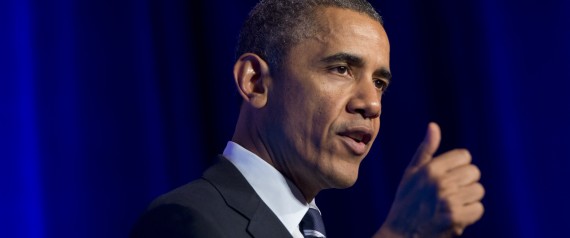
obama minimum wageWASHINGTON -- President Barack Obama is throwing his support behind congressional Democrats' proposal to raise the minimum wage to $10.10 and peg it to inflation, more than a dollar higher than the $9 proposal he made in his State of the Union address in February.
A White House official confirmed to HuffPost Thursday that the administration backs the legislation introduced earlier this year by Sen. Tom Harkin (D-Iowa) and Rep. George Miller (D-Calif.). The Hill reported Thursday that Senate Majority Whip Dick Durbin (D-Ill.) said the White House was willing to get onboard with the measure.
"The President has long supported raising the minimum wage so hardworking Americans can have a decent wage for a day’s works to support their families and make ends meet, and he supports the Harkin/Miller bill that accomplishes this important goal," the White House official said in an email.
Harkin and Miller have said that a minimum wage hike to $9 would be insufficient. The president's support of the $10.10 proposal may help more Democrats rally around the bill as the Senate takes it up in coming weeks.
"We are very pleased President Obama endorsed a $10 an hour minimum wage bill," Aaron Albright, a spokesman for Miller, said in an email. "This action unites all Democrats and minimum wage advocates behind one proposal that addresses income inequality in a powerful way. Congress must move to raise the minimum wage now."
The White House's move was applauded by advocates for low-wage workers, who haven't seen the federal minimum wage raised since 2009, after a series of increases signed into law by President George W. Bush. In states that don't mandate a higher one, the wage floor remains $7.25 per hour.
"The White House got this ball rolling in a big way by putting this in the State of the Union," said Judy Conti, federal advocacy coordinator at the National Employment Law Project. "I think they've come to a point where they realize the economy deserves a robust minimum wage. The jobs we're creating are hourly jobs with low wages. We need to do everything we can to raise it."
The $10.10 figure in the Harkin-Miller proposal isn't arbitrary. Progressive economists like to point out that if the minimum wage had kept pace with inflation since its high in the late 1960s, it would now be above $10. Of course, it's possible the president's original $9 proposal could weaken Democrats' bargaining position with the House GOP. Republicans may seek a smaller minimum wage hike, if they agree to one at all. Republican leaders have already called it a job-killer.
During his State of the Union address, Obama argued that hiking the minimum wage would improve the lives of millions of workers and their families.
"Even with the tax relief we’ve put in place, a family with two kids that earns the minimum wage still lives below the poverty line. That’s wrong," Obama said. "Tonight, let’s declare that in the wealthiest nation on Earth, no one who works full time should have to live in poverty."
While the federal minimum wage has held steady, many states and municipalities have continued to raise or implement their own minimum wages. Just this week, New Jersey voters approved a minimum wage bump to $8.25 per hour. Last month, California lawmakers raised theirs to $10, making it the highest state minimum wage in the nation.
The congressional Democrats' proposal would raise the minimum wage to $10.10 through a series of increases, then it would be adjusted each year according to inflation. The minimum wage would also rise for restaurant servers and other tipped workers, whose employers can pay them as little as $2.13 before tips. The minimum wage for those workers would be set at 70 percent of the regular minimum wage.