Showing posts with label manufacturing. Show all posts

Wednesday, December 4, 2013

If Increasing the Minimum Wage Doesn't Cost Jobs, How Does It Get Absorbed?


If Increasing the Minimum Wage Doesn't Cost Jobs, How Does It Get Absorbed? 

Jared Bernstein

As I stressed in a recent post, the economic arguments against moderate increases in the minimum wage lack robust empirical support. Most importantly, the majority of studies looking for the job-loss effects that opponents assert will be large enough to offset the benefits to low-wage workers come up short. Such "disemployment" effects hover about zero, as shown in Figure 1 from economist John Schmitt's recent reviewof the literature.
This fact raises another question: if not through job loss, how is the mandated wage increase absorbed? It's got to come out somewhere. Have economists identified the absorption channels?
We have, though there's more evidence for some absorption channels than others. Here's a quick primer on what we know and what we suspect.
First, as alluded to at the end of my earlier post, the initial question you want to ask is what share of the workforce is in the affected range and just how "affected" are they? A small increase, particularly one that's come after many years of inaction, will affect few workers and in such cases there's just not that much absorption that needs to take place.
Moreover, once a worker is in the "sweep" of the higher minimum (i.e., their hourly wage is between the old and new wage), there's the issue of where they are in the sweep. If their wage puts them a few pennies below the new minimum, we'd expect less of an impact than if it will take $1 to bring them up to the new floor.
Schmitt examines this question from various angles in the context of recent minimum wage increases (see his table 1). Starting in the late 1980s, he finds 6 percent or less of the workforce has been in the sweep, with the average hourly wage increase ranging from around thirty to fifty cents. Is this a lot or a little?
History suggests that it's a small enough impact that the wage increase tends to be absorbed not by job loss but by the various mechanisms discussed next. Let's start with the three p's: profits, productivity, and prices. Increased labor costs can be offset by:
-Shaving profit margins: This is an attractive alternative right now, as the profit share of national income is at an all-time high while the compensation share is at a 50-year low. As James Surowiecki points out, this mechanism is limited by the fact that profit margins are thinner at retail and fast food companies than at tech firms and investment banks. Still, the fact is that Walmart, for example, is a highly profitable enterprise with low-labor costs as a key part of their model.
There's little evidence for this mechanism, though a recent study from the UK finds a significant effect. You ask me, the fact that the affected lobbies fight so hard against higher minimum wages is pretty strong circumstantial evidence that this channel is at work.
A related mechanism emphasized by Schmitt is wage compression, i.e., along with some redistribution from profits to wage, there's some empirical support for "... the possibility that employers may compensate for higher wage costs at the bottom by cutting wages of workers who nearer to the top."
-Higher productivity: One of the inefficiencies that low-wage firms face is high rates of turnover and vacancies. Raising the wage floors can help offset such costs by making easier to recruit, train, and hold onto workers. Schmitt cites numerous studies as this process at work, as labor turnover has been found to decrease substantially following an increase in the wage floor.
-Higher prices: This one has been carefully studied, and the results show that part of the cost of the wage increase is passed through to higher prices. The literature finds small overall effects on the price level: a 10 percent increase in the minimum is associated with less than half a percent increase in the overall price level, though larger increases are found in low-wage labor intensive industries (around 1-4 percent).
Schmitt ticks through other possible absorption sources but there's either little research on them or what there is doesn't find much impact, including reduced hours, lower non-wage benefits, less spending on training, or greater product demand by recipients of the now-higher paychecks.
So there are lots of ways in which firms and economies absorb minimum wage increases. Not all are benign -- higher prices, lower profits -- though the fact that some of increase is absorbed by squeezing inefficiencies out of the low-wage labor market seems like an unequivocal plus. But at the end of the day, what's most important here is that the research supports the contention that the benefits of the increase in the wage floor to low-wage workers significantly outweigh the costs.
That's why you see such workers and their advocates pressing hard for the increase. And to the lobbyists who say they're really just trying to protect these benighted workers from the unintended consequences of the increase, I'm quite certain they'd say, "thanks, but no thanks... we got this."
This post originally appeared at Jared Bernstein's On The Economy blog.
 

Follow Jared Bernstein on Twitter: www.twitter.com/econjared

Monday, December 2, 2013

The Minimum We Can Do

The Minimum We Can Do

The Great Divide
The Great Divide is a series about inequality.
During most of the 20th century, wages in the United States were set not just by employers but by a mix of market and institutional mechanisms. Supply and demand were important factors; collective bargaining and minimum wage laws also played a key role. Under Presidents Franklin D. Roosevelt and Richard M. Nixon, we even implemented more direct forms of wage controls.
These direct interventions, however, were temporary, and unions have become rare in most parts of the United States — virtually disappearing from the private sector. This leaves minimum wage policies as one of the few institutional levers for setting a wage standard. But while we can set a wage floor using policy, should we? Or should we leave it to the market and deal with any adverse consequences, like poverty and inequality, using other policies, like tax credits and transfers? These longstanding questions take on a particular urgency as wage inequality continues to grow, and as we consider specific proposals to raise the federal minimum wage — currently near a record low — and to index future increases to the cost of living.
The idea of fairness has been at the heart of wage standards since their inception. This is evident in the very name of the legislation that established the minimum wage in 1938, the Fair Labor Standards Act. When Roosevelt sent the bill to Congress, he sent along a message declaring that America should be able to provide its working men and women “a fair day’s pay for a fair day’s work.” And he tapped into a popular sentiment years earlier when he declared, “No business which depends for existence on paying less than living wages to its workers has any right to continue in this country.”

This type of concern for fairness actually runs deep in the human psyche. There is a widespread sense that it is unfair of employers to take advantage of workers who may have little recourse but to work at very low wages. For example, the economists Colin F. Camerer and Ernst Fehr have documented in numerous experimental studies that the preference for fairness in transactions is strong: individuals are often willing to sacrifice their own payoffs to punish those who are seen as acting unfairly, and such punishments activate reward-related neural circuits. People also strongly support banning transactions they see as exploitative of others — even if they think such a ban would entail some economic costs.
Of course, if most minimum wage workers were middle-class teenagers, many of us might shrug off concerns about their wages, since they are taken care of in other ways. But in reality, the low-wage work force has become older and more educated over time. In 1979, among low-wage workers earning no more than $10 an hour (adjusted for inflation), 26 percent were teenagers between 16 and 19, and 25 percent had at least some college experience. By 2011, the teenage composition had fallen to 12 percent, while over 43 percent of low-wage workers had spent at least some time in college. Even among those earning no more than the federal minimum wage of $7.25 in 2011, less than a quarter were teenagers.
Support for increasing the minimum wage stretches across the political spectrum. As Larry M. Bartels, a political scientist at Vanderbilt, shows in his book “Unequal Democracy,” support in surveys for increasing the minimum wage averaged between 60 and 70 percent between 1965 and 1975. As the minimum wage eroded relative to other wages and the cost of living, and inequality soared, Mr. Bartels found that the level of support rose to about 80 percent. He also demonstrates that reminding the respondents about possible negative consequences like job losses or price increases does not substantially diminish their support.
These patterns show up in recent survey data as well, as over three-quarters of Americans, including a solid majority of Republicans, say they support raising the minimum wage to either $9 or $10.10 an hour. It is therefore not a surprise that when they have been given a choice, voters in red and blue states alike have consistently supported, by wide margins, initiatives to raise the minimum wage. In 2004, 71 percent of Florida voters opted to raise and inflation-index the minimum wage, which today stands at $7.79 per hour. That same year, 68 percent of Nevadans voted to raise and index their minimum wage, which is now $8.25 for employees without health benefits. Since 1998, 10 states have put minimum wage increases on the ballot; voters have approved them every time.
But the popularity of minimum wages has not translated into legislative success on the federal level. Interest group pressure — especially from the restaurant lobby — has been one factor. Ironically, the very popularity of minimum wages may also have contributed to the failure to automatically index the minimum wage to inflation: Democratic legislators often prefer to increase the wage themselves since it allows them to win more political points. While 11 states currently index the minimum wage, only one, Vermont, did so legislatively; the rest were through ballot measures.
As a result of legislative inaction, inflation-adjusted minimum wages in the United States have declined in both absolute and relative terms for most of the past four decades. The high-water mark for the minimum wage was 1968, when it stood at $10.60 an hour in today’s dollars, or 55 percent of the median full-time wage. In contrast, the current federal minimum wage is $7.25 an hour, constituting 37 percent of the median full-time wage. In other words, if we want to get the minimum wage back to 55 percent of the median full-time wage, we would need to raise it to $10.78 an hour.
International comparisons also show how out of line our current policy is: the United States has the third lowest minimum wage relative to the median of all Organization for Economic Cooperation and Development countries. This erosion of the minimum wage has been an important contributor to wage inequality, especially for women. While there is some disagreement about exact magnitudes, the evidence suggests that around half of the increase in inequality in the bottom half of the wage distribution since 1979 was a result of falling real minimum wages. And unlike inequality that stems from factors like technological change, this growth in inequality was clearly avoidable. All we had to do to prevent it was index the minimum wage to the cost of living.
The social benefits of minimum wages from reduced inequality have to be weighed against possible costs. When it comes to minimum wages, the primary concern is about jobs. The worry comes from basic supply and demand: When labor is made more costly, employers will hire less of it. It’s a valid concern, but what does the evidence show?
For the type of minimum wage increases we have implemented in the United States, the best evidence shows that the impact on jobs is small, although there is still a debate in the literature. There are estimates that do suggest job losses — most prominently associated with work by the economists David Neumark and William Wascher. Since the early 1990s, they have consistently argued that minimum wage increases lead to substantial job losses for low-wage workers: a 10 percent increase in the minimum wage can be expected to reduce jobs among a group like teenagers by between 1 and 3 percent. The methodology pioneered by Mr. Neumark and Mr. Wascher has a critical problem, however: it does not properly account for differences between high- and low-minimum-wage states. Essentially, they make the unrealistic assumption that low-wage employment trajectories are similar in states as diverse as Texas and Massachusetts.
As my colleagues and I show in our research, the states raising minimum wages have had very different trajectories when it comes to trends in demand conditions and business cycle variability. In fact, low-wage employment was often already falling (or growing more slowly) in the states raising the minimum wage — sometimes years before the actual wage increase. Such divergence in trends between the “treatment” and “control” groups is a telltale sign that the control group is being constructed improperly — a major issue for evaluating policies using nonexperimental evidence, otherwise known as real life.
The good news is that today we have much better tools in our toolbox. A particularly reliable methodology compares adjacent counties that are right across the state border but that experience different minimum wage shocks. Originally performed for a single case study of Pennsylvania and New Jersey by the economists David Card and Alan B. Krueger in 1994 and then again in 2000, this methodology has been substantially refined and expanded.
In my work with T. William Lester and Michael Reich, we use nearly two decades’ worth of data and compare all bordering areas in the United States to show that while higher minimum wages raise earnings of low-wage workers, they do not have a detectable impact on employment. Our estimates — published in 2010 in the Review of Economics and Statistics — suggest that a hypothetical 10 percent increase in the minimum wage affects employment in the restaurant or retail industries, by much less than 1 percent; the change is in fact statistically indistinguishable from zero.
In my most recent work with Sylvia Allegretto, Ben Zipperer and Michael Reich, we confirm these results using four data sets covering over two decades, other low-wage groups like teenagers, and five different statistical techniques, including an increasingly popular method that uses past economic trends to construct a “synthetic” control group. And other researchers have independently reached the same conclusion: minimum wage effects on employment are small.
While the evidence may not convince the most strident of critics, it has shifted views among economists. A panel of 41 leading economists was asked recently by the University of Chicago’s Booth School of Business to weigh in on President Obama’s proposal to increase the minimum wage and automatically index it to inflation. A plurality, 47 percent, supported the policy, and only 11 percent opposed it, while the rest were uncertain or had no opinion. Only a third thought that the raise “would make it noticeably harder for low-skilled workers to find employment.”
But how can minimum wages rise without causing job losses? For starters, if the demand for burgers is not price sensitive, some of the cost increase can be passed on to customers without substantially reducing demand or jobs. Existing research suggests that if you raise the minimum wage by 10 percent, you can expect the price of a $3 burger to rise by a few cents, which is enough to absorb a sizable part of the wage increase.
Going beyond simple supply and demand, economic models are getting better at incorporating frictions caused by the costs of finding jobs and filling vacancies, which turn out to be quite important when analyzing labor markets. There are good jobs and bad jobs at the low end of the labor market, and movements between these lead to vacancies and turnover. If McDonald’s is required to pay a higher wage, fewer of its workers will leave to take other jobs. This means fewer vacancies at McDonald’s, and it means other employers are more likely to fill their job openings from the ranks of the unemployed — both of which can help keep unemployment down. So while higher costs may dissuade some employers from creating new positions, it also helps other employers recruit and retain workers. Moderate increases in the minimum wage, in other words, can reduce vacancies and turnover instead of killing jobs. In a follow-up study using our bordering areas methodology, we provide empirical evidence for this argument: while overall employment in low-wage sectors does not change much following a minimum-wage increase, worker turnover falls sharply as workers stay with their jobs longer.
But even if minimum wage policies reduce inequality and improve the functioning of low-wage labor markets, are there better alternatives when it comes to helping low-income families?
In a forthcoming study commissioned by the Department of Labor, I review the evidence using data from the past two decades and find clear evidence that minimum wage raises have helped lift family incomes at the bottom: a 10 percent increase in the minimum wage reduces poverty by around 2 percent.
The minimum wage can also increase the efficacy of a policy that is sometimes pushed as a substitute: the earned-income tax credit. This encourages more people to seek work, but can push wages down; a minimum wage ameliorates this. Of course, many families under the poverty line simply have no workers, making any work-based policy of limited help. This is why raising and indexing the minimum wage is just a part of the portfolio of policies we need to enact to ensure a decent living standard.
What are actual policy options when it comes to raising the minimum wage? At the federal level, the legislation proposed by Senator Tom Harkin, Democrat of Iowa, and Representative George Miller, Democrat of California, would raise the minimum wage to $10.10 an hour, and index it to future cost of living increases. This is a sensible target that would be likely to put the minimum wage right around 50 percent of the median wage for full-time workers — close to the international standard and our own norm during the 1960s and ’70s. Indexation is critical — it replaces politics with economics as the adjustment mechanism and makes changes predictable. This is why even economists opposed to higher minimum wages support indexation.
Other policies can complement the federal minimum wage in building higher wage standards. City and state minimum wages play an important role in ensuring that places with higher costs of living have similarly higher wage standards. A number of cities have instituted “living wage” ordinances covering public sector workers and private city contractors. The most expansive of these ordinances cover major airports, like in the metropolitan areas of San Francisco, Los Angeles and most recently Seattle. Fast food workers in urban centers are beginning to organize and push for substantially higher voluntary wage standards at major chains. Together with a sensible federal minimum wage, these local initiatives can help rebuild wage standards and reduce inequality in a way that reflects our internal sense of fairness.

Arindrajit Dube is an associate professor of economics at the University of Massachusetts, Amherst, and a research fellow at IZA.
A version of this article appears in print on 12/01/2013, on page SR5 of the NewYork edition with the headline: The Minimum We Can Do.

Monday, November 18, 2013

Wal-Mart Asks Workers To Donate Food To Its Needy Employees

Wal-Mart Asks Workers To Donate Food To Its Needy Employees

walmart checkout Ashley Lutz 58 minutes ago 4,056 14

walmart checkout

Walmart Media Relations


A Cleveland Wal-Mart store is holding a food drive — for its own employees.

"Please donate food items so associates in need can enjoy Thanksgiving dinner," reads a sign accompanied by several plastic bins.

The Cleveland Plain Dealer first reported on the food drive, which has sparked outrage in the area.

"That Wal-Mart would have the audacity to ask low-wage workers to donate food to other low-wage workers — to me, it is a moral outrage," Norma Mills, a customer at the store, told the Plain Dealer.

A company spokesman defended the food drive, telling the Plain Dealer that it is evidence that employees care about each other.

"This store has been doing this for several years and is for associates that have faced an extreme hardship recently," spokesman Kory Lundberg told us.

Lundberg says an example of this would be a recent layoff in the family or some other financial hardship.

Wal-Mart has been criticized for paying low wages to its 2.2 million employees.

Last week, 50 people were arrested after protesting the retailer's pay at a store in Los Angeles.

Wal-Mart turned a profit of $15.7 billion last year.

SEE ALSO:  Facts About Wal-Mart That Will Blow Your Mind

Read more: http://www.businessinsider.com/walmart-asks-customers-to-donate-food-2013-11#ixzz2l1IUPjsq

Friday, November 8, 2013

America Is Ruled by Billionaires, and They Are Coming After the Last Shreds of Our Democracy


America is a plutocracy through and through -- what are we going to do about it?
 
Plutocracy literally means rule by the rich. “Rule” can have various shades of meaning: those who exercise the authority of public office are wealthy; their wealth explains why they hold that office; they exercise that authority in the interests of the rich; they have the primary influence over who holds those offices and the actions they take. These aspects of “plutocracy” are not exclusive. Government of the rich and for the rich need not berun directly by the rich. Also, in some exceptional circumstances rich individuals who hold powerful positions may govern in the interests of the many, e.g. Franklin Roosevelt.
The United States today qualifies as a plutocracy – on a number of grounds.  Let’s look at some striking bits of evidence. Gross income redistribution upwards in the hierarchy has been a feature of American society for the past decades. The familiar statistics tell us that nearly 80% of the national wealth generated since 1973 has gone to the upper 2%, 65% to the upper 1 per cent. Estimates as to the rise in real income for salaried workers over the past 40 years range from 20% to 28 %. In that period, real GDP has risen by 110% – it has more than doubled.
To put it somewhat differently, according to the Congressional Budget Office,  the top earning 1 percent of households gained about 8X more than those in the 60 percentile after federal taxes and income transfers over a period between 1979 and 2007; 10X those in lower percentiles.  In short, the overwhelming fraction of all the wealth created over two generations has gone to those at the very top of the income pyramid.  That pattern has been markedly accelerated since the financial crisis hit in 2008. Between 2000 and 2012, the real net worth of 90% of Americans has declined by 25%.  Theoretically, there is the possibility that this change is due to structural economic features operating nationally and internationally. That argument won’t wash, though, for three reasons. First, there is no reason to think that such a process has accelerated over the past five years during which disparities have widened at a faster rate. Second, other countries (many even more enmeshed in the world economy) have seen nothing like the drastic phenomenon occurring in the United States. Third, the readiness of the country’s political class to ignore what has been happening, and the absence of remedial action that could have been taken, in themselves are clear indicators of who shapes thinking and determines public policy. In addition, several significant governmental actions have been taken that directly favor the moneyed interests.
The latter include the dismantling of the apparatus to regulate financial activities specifically and big business generally. Runaway exploitation of the system by predatory banks was made possible by the Clinton “reforms” of the 1990s and the lax application of those rules that still prevailed. Attorney General Eric Holder just a few weeks ago went so far as to admit that the Department of Justice’s decisions on when to bring criminal charges against the biggest financial institutions will depend not on the question of legal violations alone but would include the hypothetical effects on economic stability of their prosecution. Earlier, Holder had extended blanket immunity to Bank of America and other mortgage lenders for their apparent criminality in forging, robo-signing, foreclosure documents on millions of home owners. In brief, equal protection and application of the law has been suspended. That is plutocracy.
Moreover, the extreme of a regulatory culture that, in effect, turns public officials into tame accessories to financial abuse emerged in stark relief at the Levin Committee hearings on J P Morgan Chase’s ‘London Whale” scandal. Morgan officials stated baldly that they chose not to inform the Controller of the Currency about discrepancies in trading accounts, without the slightest regard that they might be breaking the law, in the conviction that it was Morgan’s privilege not to do so. Senior regulators explained that they did not see it as their job to monitor compliance or to check whether claims made by their Morgan counterparts were correct. They also accepted abusive treatment, e.g. being called “stupid” to their face by senior Morgan executives. That’s plutocracy at work.  The Senate Finance Committee hearing drew only 3 senators – yet another sign of plutocracy at work. When mega-banks make illicit profits by money laundering for drug cartels and get off with a slap on the wrist, as has HSBC and others, that too is plutocracy.
When the system of law that is meant to order the workings of society without reference to ascriptive persons is made malleable in the hands of officials to serve the preferred interests of some, it ceases to be a neutral instrument for the common good. In today’s society, it is becoming the instrument of a plutocracy.
There are myriad other examples of complicity between legislators or regulators, on the one hand, and special business interests on the other. EPA judgments that are reversed under the combined pressure of the commercial interests affected and beholden politicians is one. The government’s decision not to seek the power to bargain with pharmaceutical companies over the price of drugs paid for with public funds is another. Tolerance for the concealment of offshore profits in the tens of billions is a third. Relaxed interpretations of the tax laws by the IRS to the advantage of high income persons can be added to the list. So, too, can the give-away to sole source contractors of the tens of billions squandered in Iraq and Afghanistan. The number of such direct assists to big business and the wealthy is endless. The point is that government, at all levels, serves particular selfish interests no matter who holds high positions. While there is some difference between Republicans and Democrats on this score, it has narrowed on most major items to the point that the fundamental properties of the biased system are so entrenched as to be impervious to electoral outcomes. The most revealing experience that we have of that harsh reality is the Obama administration’s strategic decision to allow Wall Street to determine how and by whom the financial crisis would be handled.
Systemic biases are the most crucial factor is creating and maintaining plutocratic orientations of government. They are confirmed, and reinforced, by the identities and identifications of the persons who actually hold high elected office. Our leaders are nearly all rich by any reasonable standard. Most are very rich. Those who weren’t have aspired to become so and have succeeded. The Clintons are the striking case in point. That aspiration is evinced in how they conduct themselves in office. Congress, for its part, is composed of two rich men/women’s clubs. In many cases, personal wealth helped win them their offices. In many others, they knit ties with lobbies that provided the necessary funds.  Whether they are “bought off” in some sense or other, they surely are often coopted. The most insidious aspect of cooptation is to see the world from the vantage point of the advantaged and special economic interests.
The devolution of the Democratic Party from being the representative of ordinary people to being just “another bunch of guys” is a telling commentary on how American politics has degenerated into a plutocracy. The party’s rolling over to accommodate the interests of the wealthy has been a theme of the past four years. From the Obama White House to the halls of Congress, party leaders (and most followers) have conceded the dominance of conservative ideas about macro-economic strategy (the austerity dogma), about retaining largely untouched the for-profit health care “non-system,” about bailing out the big financial players as the expense of everyone else and the economy’s stability, about degrading Social Security and Medicare. The last item is the most egregious – and revealing – of our plutocratic ways and means. For it entails a combination of intellectual deceit, blatant massaging of the numbers, and disregard for the human consequences in a time of growing distress for tens of millions. In other words, there is no way to conceal or spin the trade-offs made, who was being hurt and who would continue to enjoy the advantages of skewed fiscal policies.
There is another, absolutely crucial dimension to the consolidation of America’s plutocracy. It is controlling the means to shape how the populace understands public matters and, thereby, to channel thought and behavior in the desired direction. Our plutocratic guides, prophets and trainers have been enormously successful in accomplishing this. One object of their efforts has been to render the media into either conscious allies or to denature them as critics or skeptics. Their success is readily visible.
Who has challenged the plutocracy serving falsehood that Social Security and Medicare are the main cause of our deficits whose imminent bankruptcy puts in jeopardy the American economy? Who even bothers to inform the public that those two programs’ trust funds draw on a separate revenue source from the rest of the budget? Answer: no one in or near the mainstream media. Who has performed the most elementary service in pointing out that of all the jobs created since 2009, small as the number has been, 60% at least have been either part-time or temporary? Answer: again, no one. Who has bothered to highlight the logical flaws in the market fundamentalist view of the world that has so deformed perceptions of what works and doesn’t work in macro-economic management? Yes, Paul Krugman, Joseph Stiglitz and a handful of others – although even Krugman’s colleagues writing on business and economics  at the NYT seem not to have the time to read him or else lack the wit to comprehend what he is saying.
A second objective in a similar vein has been to dominate the think tank/foundation world. Today, nearly every major Washington think tank depends on corporate money. Businessmen sit on the boards and shape research programs. Peter G. Peterson, the hedge fund billionaire, took the more direct route of acquiring the International Institute of Economics, renaming it after himself. He then set about using it as in instrument to carry on the campaign against Social Security which has become his life’s work. Then there is Robert Rubin. Rubin is the distilled essence of financial malpractice, and the embodiment of the government-Wall Street nexus that brought the country to wrack and ruin.  Author of Clinton’s deregulation program while Secretary of the Treasury: later super lobbyist and Chairman of CITI bank in the years before it was pulled from the brink of bankruptcy by Ben Bernanke, Paulson and Tim Geithner; and adviser to Barack Obama who stocked the new administration with Rubin protégés.  He since has ensconced himself as Chairman of the Council on Foreign Relations and Director of the highly prestigious, lavishly funded Hamilton Project at Brookings. By happenstance, both organizations late last year featured presentations by Jaime Dimon. The one billed as a forum for a leading global CEO to share priorities and insights before a high-level audience of CFR  members.          
That is plutocracy in action.
The third objective has been to weaken public education. We have witnessed the assault on our public elementary school system in the name of effectiveness, efficiency and innovation. Charter schools are the watchword. Teachers are the heart of the problem. So privatization, highly profitable privitization, is sold as the solution to save America’s youth in the face of ample evidence to the contrary. Cast aside is the historical truth that our public school system is the one institution, above all others, that made American democracy. It also is a bastion of enlightened social thinking. It thereby qualifies as a target. The same for the country’s proud network of public universities. From state to state, they are starved for funding and made sacrificial lambs on the altar of the austerity cult.  They, too, are stigmatized as “behind the times,” as no longer doing the job of supplying the business world with the obedient, practical skilled workers it wants. Business schools, long a dependency of the corporate world, as held up as the model for private-public partnership in higher education.  Distance learning, often managed by for-profit ‘expert” consultants or “entrepreneurs”, is advertised as the wave a bright future – a future with fewer liberal-leaning professors with fuzzy ideas about the good society. Distance learning is the higher education companion to the charter school fad. Lots of promises, little delivery but well conceived to advance a plutocracy friendly agenda.
Here, too, boards of regents are led by business men or women.  The abortive coup at the University of Virginia was instigated by the Rector who is a real estate developer in Virginia Beach. The Chairman of the Board of Regents at the University of Texas system where tensions are at a combustible level is a real estate developer. The Chairman at the University of California is CEO of two private equity firms – and the husband of Senator Diane Feinstein. His pet project was to have the moneys of the California teacher’s pension fund placed in the custody of private financial houses. Two former directors of the fund currently are under criminal investigation for taking very large kick-backs from other private equity firms to whom they directed monies – and which later employed them as ‘placers.’ That’s plutocracy at work.
The ultimate achievement of a plutocracy is to legitimize itself by fixing in the minds of society the idea that money is the measure of all things. It represents achievement, it is the sine qua non for giving people the material things they want. It is the gauge of an individual’s worth. It is the mark of status in a status anxious culture. That way of seeing the world describes the outlook of Bill Clinton and Barack Obama.  It is Obama who, at the height of the financial meltdown, lauded Jaime Dimon and Lloyd Blankfein  as “savvy and successful businessmen.” It is Obama who eagerly became Dimon’s golfing buddy – an Obama who twice in his career took jobs with corporate law firms. It was Bill Clinton who has been flying the world in corporate jets for the past twelve years. It is the two of them who promoted Alan Simpson and Erskine Bowles to press for the crippling of Social Security. That’s plutocracy pervading the leadership ranks in both parties of what used to be the American republic.
Perhaps the most extraordinary achievement of the plutocracy’s financial wing has been to win acceptance from the country’s entire political class that its largely speculative activities are normal. Indeed, they are credited with being the economy’s principal engine of growth. It follows that their well-being is crucial to the well-being of the national economy and, therefore, they should be given privileged treatment.
*******
The American version of plutocracy is noteworthy for its crassness. Subtlety, discretion and restraint are foreign to it. It has a buccaneering quality. That style has roots in the country’s history and culture. Much of the behavior is impulsive, grasping.  Individuals are greedy for vivid displays that they are top dog, of what they can get away with, as well as the riches themselves. There is little interest in building anything that might endure – no ‘new order,’ no new party, no new institutions. Not even physical monuments to themselves. Why bother when the existing set-up works so well to your advantage, to that of your like-minded and like-interested associates – when you can turn ideas, policies and money in your direction with ease. And while the public is blind to how they are being deluded and abused. After all, the more things appear to stay the same, the more they can change in a country whose civic ideology imbues everyone with the firm belief that its principles and institutions embody a unique virtue. To challenge any of that would be to run the risk of raising consciousness – which is the last thing that the plutocrats want.
There are exceptions. The most stunning is Wall Street’s biggest players’ audacity in coopting a part of the NYC Police Department in setting up a semi-autonomous unit to monitor the financial district. Funded by Goldman Sachs et al, managed by private ban employees in key administrative positions, and with an explicit mandate to prevent, as well as to deal with any activity that threatens them, it operates with the latest high tech equipment out of a dedicated facility provided by its sponsors. The facility for years was kept “under the counter” so as not to tempt inquisitive parties to expose it. This is the unit that coordinated the squelching of theOccupy movement’s Manhattan demonstrations. It represents the appropriation of a public agency to serve and to serve under private interests. The post-9/11 hyper-anxiety provided political and ideological cover for a deal devised by Mayor Mike Bloomberg (himself a Wall Street billionaire who has gone down the line to defend it against all charges of financial abuse) in collusion with his former associates.  Is this simply Bloomberg registering NYC’s fiscal dependency on financial sector jobs? Well, this is the same Bloomberg who killed a widely supported initiative to set a minimum decent wage of $10 an hour with health insurance ($11.50 without) on development projects that receive more than $1 million in taxpayer subsidies. He stigmatized the measure as “a throwback to the era when government viewed the private sector as a cash cow to be milked…. The last time we really had a big managed economy was the USSR and that didn’t work out so well.”  That’s as plutocratic as it gets – and in liberal New York.
Furthermore, the moving forces of the plutocracy are not very organized. There is no conspiracy as such. It is the convergence of outlook among disparate persons in different parts of the system that has accomplished the revolution in American public life, public discourse, and public philosophy. Nobody had to indoctrinate Barack Obama in 2008-2009 or intimidate him or bribe him. He came to the plutocrats on his own volition with his mind-set and values already in conformity with the plutocracy’s view of itself and of America. This is the man who, for the first two years of his presidency, repeatedly misstated the coverage of the Social Security Act of 1935 – ignorant and not bothering to find out or willfully ignorant so as to create a convenient comparison with his fatally flawed health care pseudo-plan. This was the man, after all, who cited Ronald Reagan as model for what sort of presidency American needed. He has been living proof of how effectively Americans had been brought into line with the plutocratic vision.
This is not to say that the plutocrats’ success was inevitable – or that they were diabolically clever in manipulating everything and everyone to their advantage. There has been a strong element of good fortune in their victory. Their most notable piece of luck has been the ineptitude and shortsightedness of their potential opposition – liberal Democrats, intellectuals, and their like.  The plutocrats pursued their goals is a disorganized, diffuse way. However, the absence of an opponent on the contested terrain assured success.
As to cleverness, the American plutocracy is actually a stupid plutocracy. First, it is overreaching. Far better to leave a few goodies on the table for the 99% and even a few crumbs for the 47% than to risk generating resentment and retaliation. Since the financial meltdown, financial and business interests have been unable to resist picking the pockets of the weak. Fishing out the small change in the wake of grand larceny is rubbing salt into wounds.  Why fight a small rise in the minimum wage? Why ruthlessly exploit all those temps and part-timers who have so little in the way of economic power anyway? Why squeeze every last buck from the small depositors and credit card holders whom you already systematically fleece? In the broad perspective, that sort of behavior is stupid.
To explain it, we must look to the status compulsions of America’s audacious corporate freebooters. These peculiar traits grow more intense the higher one goes in the hierarchy of riches. One is the impulse to show to everybody your superiority by displaying what you can get away with. “Sharp dealing” always has been prized by segments of American society. It’s the striving, insecure man who has to prove to the world – and to himself – that he can act with impunity. He is little different from the hoodlum showing off to his pals and to his moll. These people at heart are hustlers – they crave the thrill of pulling off a scam, not constructing something.
Hence, Lloyd Blankfein not showing up for White House meetings yet having Obama thank him for letting the president know, albeit after the meeting already had begun, that Blankfein can’t make it. Hence, Jaime Dimon indignantly protesting his verbal mistreatment by the press, by the White House, by whomever. Then there is Jack Welch, the titan of American industry who struts sitting down, who holds the Guinness record for the most manufacturing jobs outsourced by one company – and yet impudently calls Barack Obama “anti-business” after the president appoints his hand-picked successor, Jeffrey Immelt, to head the White House’s Job Council. Or Bank of America’s faking compliance with the sweetheart deal it got from Obama on the felonious foreclosure scam.
The ultimate episode of egregious lawlessness is the MF Holdings affair – whereby under its chief, former Senator and Governor Jon Corzine, this hedge fund took the illegal action of looting a few billion from custodial accounts to cover losses incurred in its proprietary trading. JP Morgan, which held MF Global funds in several accounts and also processed the firm’s securities trades, resisted transferring the funds to MF’s customers until forced to by legal action. Punitive action: none. Why? The Justice Department and regulatory bodies came up with the lame excuse that the MF group’s decision-making was so opaque that they could not determine whose finger clicked the mouse. To pull capers like these and get off scot free, without chastisement, is the ultimate ego trip.
Willie Sutton, the notorious bank robber of the 1940s, explained his targeting banks this way: “that’s where the money is.” Today’s financial swindlers go after the high risk gambles because that’s where the biggest kicks are. That is more important than the biggest bucks – although they add to the thrill. For the ever status striving, identity insecure financial baron is a compulsive gambler. He needs his fixes. Of winning, of celebrity, of respect. Of deference. All are transitory, though. For American culture provides few insignia of rank. No ‘Sirs,’ no seats in the House of Lords, no rites of passage that separate the heralded elite from all the rest. Oblivion shadows the most famous and acclaimed.
Thus, the grasping for whatever badges of regard are within reach – however ludicrous they might be.   When IR Magazine awarded JPMorgan the prize for “best crisis management” of 2012 for its handling of the London Whale trading debacle, at a black-tie awards ceremony in Manhattan, Morgan executives were there to express their appreciation, rather than bow out gracefully. The only Wall Street personage who has played the celebrity game without being marginalized in the public mind is Robert Rubin. Through nimbleness and political connection he has semi-institutionalized his celebrity status. Yes, there is Paul Volcker – but that is another world all together. His stature is built on an unmatched record of service to the commonweal and unchallenged integrity. The Blankfeins and Dimons and Welchs not only lack the critical attributes – they also lack the sense of what it means to serve the public from which they habitually distance themselves.
The plutocrats’ compulsive denigration of the poor, the ill and the dispossessed is perhaps the most telling evidence of status obsession linked to insecurity that is at the core of their social personality.  They find it necessary to stigmatize the latter as at best failures, at worst as moral degenerates – drug addicts, lazy, parasites, in part to highlight their superiority and in part to blur the human consequences of their rapacity.  Behavior of this kind is the antithesis of what could be the cultivated image of the statesman of commerce – even though they pay a price in public esteem. They also pay in price in terms of the other aspect of their own self-image.
Second, Americans have a craving to believe in their own virtue – as well as to have others recognize it.  The perverse pride in beating the system cannot in and of itself compensate for the feeling that you’re a bad guy. Blankfein again: “I have been doing the Lord’s work.” No one laughs in public – so I’m right about that. Dimon swaggering through the Council On Foreign Relations or Brookings with the huddled masses in his audience  – and on the dais –   beaming their adulation as they bask in his fame and thirst for his wisdom on the great affairs of the world. Perhaps, his views on whether the BRICS can rig the LIBOR rate with the connivance of the Bank of England and the Federal Reserve – or ignore regulatory reporting rules when they threaten to reveal a madcap scheme that loses $6 billion?
********
Plutocracy in the current American style is having pernicious effects that go beyond the dominant influence of the rich on the nation’s economy and government. It is setting precedents and modeling the unaccountability and irresponsibility that is pervading executive power throughout the society. Two successive presidential administrations and two decades of rogue behavior by corporate elites have set norms now evident in institutions as diverse as universities and think tanks, the military and professional associations. The cumulative result is a widespread degrading of standards in the uses and abuses of power.
Plutocracy also raises social tensions in society. Logically, the main line of tension should be between the plutocrats and the rest – or, at least, between them and all those with modest means. But that is not the case in the United States. While it is true that there were bitter words about the Wall Street moguls and their bailouts during the first year or so after the financial collapse, it never became the main line of political division. Today, outrage has abated and politics is all about austerity and debts rather than the distribution of wealth and the power that goes along with it.The deep-seated sense of anxiety and grievance that pervades the populace manifests in outbreaks of hostile competition among groups who are in fact themselves all victims of the plutocrats’ success in grabbing for themselves most of the country’s wealth – thereby leaving the rest of us to fight for the leftovers. So, it is private sector employees pitted against government employees because the latter have (some) health insurance, some pension and some security relative to the former who have been shorn of all three. It’s parents worried about their kids’ education against teachers. Both against cash strapped local authorities. Municipalities vs states. It’s the small businessman against unions and health insurance requirements. It’s doctors against patients against administrators. It’s university administrators against faculty and against students, faculty against students in competing for a much reduced appropriations. It’s all of those against boards of regents and state governors.
It’s everyone frustrated by the ever sharpening contrast between hopes and aspirations and darkening realities of what they might expect for themselves and their children. Meanwhile, the folks at the top wait confidently and expectantly above the fray they have engineered – ever ready to swoop down to strip the remains of combat by way of privatized public assets, no-bid contracts, tax and regulatory havens, commercially owned toll roads, student loan monopolies, rapacious buying up of foreclosed properties with federal incentives, and myriad tax breaks.
President Obama used his State of the Union Address to send the message loud and clear. “Let me put colleges and universities on notice” he warned, “If you can’t stop tuition from going up, the funding you get from taxpayers will go down.” He thereby set forth a line of reasoning that put him on the same wavelength as Rick Perry. For the reality is the exact opposite. It is because funding has gone down by 2/3 over the past few decades that colleges and universities are obliged to raise tuition – despite flat-lining faculty and staff salaries.   This is the essence of intellectual conditioning to the plutocracy’s self-serving dogma and the suborning of public authorities by the plutocracy. Beyond capture, it is assimilation.
Does this sort of perverse pride go before the fall? No sign of that happening yet. Plutocracy in America is more likely to be our destiny. The growing dynastic factor operating within the financial plutocracy militates in that direction. Wealth itself has always been transferred from one generation to another, of course; reduced inheritance taxes along with lower rates at upper income brackets generally accentuate that tendency. With socio-economic mobility in American society slipping, it gains further momentum. Something approaching a caste identity is forming among the financial elites – as personified by Jaime Dimon who is the third generation of Wall Street stockbrokers/financial managers in his family – his father an Executive Director at American Express where the young Dimon joined forces with Sandy Weill.  As a revealing coda to this generational tale, Dimon, last year, hired his 81 year old father to work for JP Morgan Chase. His father’s first-year salary was $447,000;  slated to rise to $1.6 million – now that he has some work experience under his belt, presumably.  A sense of limits is not part of the financial plutocracy’s persona.
*******
All that has been recounted here is on the public record. Facts are facts; the inferred attitudes of the plutocracy are confirmed by an abundance of data – including the players’ own statements. The consequences analyzed are also a matter of public record. The tepid reaction should be no surprise; that is exactly what is to be expected in a plutocracy.
So what is to be done? Rectify the sins of commission by rescinding them and those of omission by restoring responsible, enlightened policies. A model? How about 1974? Inglorious year, but….Richard Nixon was well to the ‘Left’ of Barack Obama – civil liberties included; corporate power, especially that of big finance, was kept in check by effective regulation; and the integrity of American institutions was a paramount concern of most elected officials and the political elite in general.
The Word awaits…but
The script is small
The preacher is blind
The audience is deaf
And the echoes ricochet off bare walls soundlessly

Obama Gets Behind Democrats' $10.10 Minimum Wage Proposal

Obama Gets Behind Democrats' $10.10 Minimum Wage Proposal

Posted:   |  Updated: 11/07/2013 6:27 pm EST


Dave Jamieson


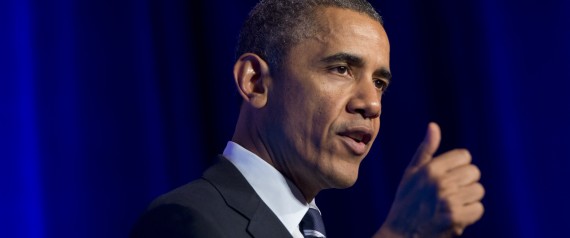
obama minimum wageWASHINGTON -- President Barack Obama is throwing his support behind congressional Democrats' proposal to raise the minimum wage to $10.10 and peg it to inflation, more than a dollar higher than the $9 proposal he made in his State of the Union address in February.
A White House official confirmed to HuffPost Thursday that the administration backs the legislation introduced earlier this year by Sen. Tom Harkin (D-Iowa) and Rep. George Miller (D-Calif.). The Hill reported Thursday that Senate Majority Whip Dick Durbin (D-Ill.) said the White House was willing to get onboard with the measure.
"The President has long supported raising the minimum wage so hardworking Americans can have a decent wage for a day’s works to support their families and make ends meet, and he supports the Harkin/Miller bill that accomplishes this important goal," the White House official said in an email.
Harkin and Miller have said that a minimum wage hike to $9 would be insufficient. The president's support of the $10.10 proposal may help more Democrats rally around the bill as the Senate takes it up in coming weeks.
"We are very pleased President Obama endorsed a $10 an hour minimum wage bill," Aaron Albright, a spokesman for Miller, said in an email. "This action unites all Democrats and minimum wage advocates behind one proposal that addresses income inequality in a powerful way. Congress must move to raise the minimum wage now."
The White House's move was applauded by advocates for low-wage workers, who haven't seen the federal minimum wage raised since 2009, after a series of increases signed into law by President George W. Bush. In states that don't mandate a higher one, the wage floor remains $7.25 per hour.
"The White House got this ball rolling in a big way by putting this in the State of the Union," said Judy Conti, federal advocacy coordinator at the National Employment Law Project. "I think they've come to a point where they realize the economy deserves a robust minimum wage. The jobs we're creating are hourly jobs with low wages. We need to do everything we can to raise it."
The $10.10 figure in the Harkin-Miller proposal isn't arbitrary. Progressive economists like to point out that if the minimum wage had kept pace with inflation since its high in the late 1960s, it would now be above $10. Of course, it's possible the president's original $9 proposal could weaken Democrats' bargaining position with the House GOP. Republicans may seek a smaller minimum wage hike, if they agree to one at all. Republican leaders have already called it a job-killer.
During his State of the Union address, Obama argued that hiking the minimum wage would improve the lives of millions of workers and their families.
"Even with the tax relief we’ve put in place, a family with two kids that earns the minimum wage still lives below the poverty line. That’s wrong," Obama said. "Tonight, let’s declare that in the wealthiest nation on Earth, no one who works full time should have to live in poverty."
While the federal minimum wage has held steady, many states and municipalities have continued to raise or implement their own minimum wages. Just this week, New Jersey voters approved a minimum wage bump to $8.25 per hour. Last month, California lawmakers raised theirs to $10, making it the highest state minimum wage in the nation.
The congressional Democrats' proposal would raise the minimum wage to $10.10 through a series of increases, then it would be adjusted each year according to inflation. The minimum wage would also rise for restaurant servers and other tipped workers, whose employers can pay them as little as $2.13 before tips. The minimum wage for those workers would be set at 70 percent of the regular minimum wage.

Monday, November 4, 2013

Hottest September On Record, Fastest Pacific Warming In 10,000 Years, Warmest Arctic In 120,000 Years

By Joe Romm on November 3, 2013 at 11:47 am

Temperature change over past 11,300 yearsTemperature change over past 11,300 years (in blue, via Science, 2013) plus projected warming on humanity’s current emissions path (in red, via recent literature.
It’s been a hot week for global warming.
NASA released global temperature data showing that this September tied with 2005 for the warmest September on record. That’s doubly impressive since 2005 was warmed by an El Niño and accompanying warm Pacific ocean temperatures, whereas 2013 has had cooler Pacific temperatures all year.
Greenhouse gases keep warming the planet to unprecedented levels with unprecedented speed. That’s the conclusion of two new studies out this week.
The first, “Unprecedented recent summer warmth in Arctic Canada,” concludes: “Our results indicate that anthropogenic increases in greenhouse gases have led to unprecedented regional warmth.”
How unprecedented? The news release explains:
Average summer temperatures in the Eastern Canadian Arctic during the last 100 years are higher now than during any century in the past 44,000 years and perhaps as long ago as 120,000 years, says a new INSTAAR study.
The study is the first direct evidence the present warmth in the Eastern Canadian Arctic exceeds the peak warmth there in the Early Holocene, when the amount of the sun’s energy reaching the Northern Hemisphere in summer was roughly 9 percent greater than today, said study leader Gifford Miller.
The Holocene is our current geological epoch. It began after Earth’s last Ice age ended some 11,700 years ago. The release notes that, “The ice cores showed that the youngest time interval from which summer temperatures in the Arctic were plausibly as warm as today is about 120,000 years ago.”
What does the unprecedented warming mean?
“The key piece here is just how unprecedented the warming of Arctic Canada is,” said Miller, also an INSTAAR fellow. “This study really says the warming we are seeing is outside any kind of known natural variability, and it has to be due to increased greenhouse gases in the atmosphere.”
And it isn’t just the level of warming that is unprecedented. It is also the rate of warming.
Columbia University’s Earth Island Institute explained that in an article Thursday, “Is Global Heating Hiding Out in the Oceans?“:
… a new study in the leading journal Science adds support to the idea that the oceans are taking up some of the excess heat, at least for the moment. In a reconstruction of Pacific Ocean temperatures in the last 10,000 years, researchers have found that its middle depths have warmed 15 times faster in the last 60 years than they did during apparent natural warming cycles in the previous 10,000.
“We’re experimenting by putting all this heat in the ocean without quite knowing how it’s going to come back out and affect climate,” said study coauthor Braddock Linsley, a climate scientist at Columbia University’s Lamont-Doherty Earth Observatory. “It’s not so much the magnitude of the change, but the rate of change.”
We are experimenting on our previously stable climate without wisdom or morality, we are experimenting on our children and grandchildren without their consent. If we don’t stop ASAP, it won’t end well.

Why do 'red states' have more poverty?

Why do 'red states' have more poverty?

Tampa : FL : USA | Feb 24, 2013 at 10:56 AM PST
Poverty in America
Why do Red States have more poor people? Image: Upworthy.com
Activists join a nationwide rally in support of health care reforms in Miami, Florida
Americans do not have to guess what the country would be like if the small-government, conservative economic agenda were implemented on a national scale.
Many Republican-controlled, predominantly Southern “red states” already have. The result is not an abundance of prosperity from under taxed “job creators,” as often touted in sound bites and on the conservative candidate campaign trail. Instead, according to the numbers, it’s quite the opposite.
Smaller government austerity policies in red states have created macroeconomic societies with high poverty and low education rates. Low-paying jobs and lack of health care also dominate states that have implemented the smaller government theories of conservative ideology.
In Texas, for example, decades of Republican control, from the governor’s office down to state and local legislatures, has kept the Tea Party ideological model in place. And it has the highest poverty rate of “any large industrial state,” according to Texas Politics data.
The data showed similar high poverty rate numbers for other red states, including Mississippi, Louisiana, Kentucky, North Carolina, and Tennessee.
Lack of health care is also a bigger problem in states following the conservative Republican ideological view of less funding for government assistance programs.
Florida Gov. Rick Scott recently acknowledged the serious economic problems associated with having more than 21 percent of the population without health insurance. The costs for hospitals treating the uninsured is so high, Scott surrendered to pressure from Florida health care providers and accepted the Medicaid expansion of the Affordable Care Act, also called Obamacare.
Hunger is also a bigger problem among states where Republicans have had their way with local budgets. And while southern red states do not have a lock on growing US poverty rates, they still lead with the worse numbers. More than 24 percent of the people in Mississippi suffer from food deficiencies, with Alabama coming in second at nearly 23 percent.
Red States also top the charts for populations with lower education levels. The top 10 include Oklahoma, Tennessee, Indiana, Nevada, Alabama, Louisiana, Kentucky, Arkansas, Mississippi and West Virginia, according to Fox Business.
There is a disturbing correlation between Republicans and high poverty rates. CNN reports that the 10 poorest states in America tend to elect Republicans. Is this because they haven’t made the connection between conservative government policy and the need for the social safety net? Or have they simply been convinced by right-wing political rhetoric to vote against their own best interests?
In addition to the disconnect between conservative policies and economic security, it has been demonstrated in states completely controlled by Republicans that consolidated power can lead to loss of personal freedom and the most fundamental elements of democracy.
In the 2012 elections, the people of Michigan voted by a 53 to 47 percent margin to repeal the state’s power to replace their local elected representatives with appointed emergency managers, in areas with struggling budget issues. “The law was intended to help municipalities avoid bankruptcy or default, but it has been criticized for infringing on the rights of local governments,” according to the New York Times.
Rather than listening to the voice of voters who repealed the law at the ballot box, Michigan legislators have ignored court orders to remove “emergency managers” and reinstated the legislation, this time adding a clause that blocks any further attempts by the public to make it a ballot initiative in the future.
Republican-controlled legislatures have also used their power to strip unions workers of their rights to collective bargaining, as Gov. Scott Walker did in Wisconsin.
So not only are Republican’s changing the fundamental economic structure of America, they are using scare tactics and misleading campaign ads to try to gain monopoly-control of as many branches of government as they can.
Salon.com put it this way:
This is the formula for a reactionary politics that does not serve the collective good….
Elites who have long been disconnected from the masses manipulate this anxiety into a politics that serves to gut the social safety net and chase down the chosen bugaboos of the Right--the "evil" unions, "liberals," "intellectuals," teachers, Muslims, immigrants, racial minorities, gays and lesbians, "overpaid" public employees, and/or anyone who is not a "real American."
In the end game, the authoritarianism infused White reactionary Tea Party AstroTurf politics of the New Right are the road to inverted totalitarianism--an order that rises out of a failure of democratic politics, a collapsed and exhausted economy, a triumphant corporatism, and the false promises of popular Conservatism.
In the 2012 elections, voters did indeed reject the policies of right-wing Republicans by giving Democratic House candidates over a million more votes. However, Republican gerrymandering after the 2010 census prevented those votes from counting toward democratic control of Congress.
Today, the only thing preventing the United States from becoming the poverty-ridden, low education, no health care, totalitarian-style government that has taken over red states is the Democratic majority in the Senate and Barack Obama in the White House.
Will voters in 2014 make the connection between their own economic interests and adversarial conservative policies and reject GOP monopoly rule? Or will they continue to vote for candidates who have demonstrated that their best abilities lie only in creating less opportunity, and more hardship and poverty than their blue state counterparts?
If you like to write about US politics, enter Allvoices’ "The American Pundit" political writing contest. Allvoices is awarding four $250 prizes each month between now and Nov. 30. These monthly winners earn eligibility for the $5,000 grand prize, to be awarded in December. If you do not already have a free account, sign up here.
The American Pundit on Twitter: https://twitter.com/AmericanPundits
Allvoices on Twitter: https://twitter.com/allvoices
Allvoices on Facebook: https://www.facebook.com/freelance.journalism
Recommended:
Republicans admit spending cuts will damage economy
Wayne LaPierre: Guns are for Armageddon and 'fun'
Is Apple’s edge gone without Steve Jobs?
Sources and more info in addition to the links above:
Child poverty in the South getting worse
'The Hunger Games' Are Here. And They Are Very, Very Real.
itobin53 is based in Tampa, Florida, United States of America, and is an Anchor for Allvoices.

9 Things The Rich Don't Want You To Know About Taxes

9 Things The Rich Don't Want You To Know About Taxes


lede_3723_pigFor three decades we have conducted a massive economic experiment, testing a theory known as supply-side economics. The theory goes like this: Lower tax rates will encourage more investment, which in turn will mean more jobs and greater prosperity—so much so that tax revenues will go up, despite lower rates. The late Milton Friedman, the libertarian economist who wanted to shut down public parks because he considered them socialism, promoted this strategy. Ronald Reagan embraced Friedman’s ideas and made them into policy when he was elected president in 1980.
For the past decade, we have doubled down on this theory of supply-side economics with the tax cuts sponsored by President George W. Bush in 2001 and 2003, which President Obama has agreed to continue for two years.
You would think that whether this grand experiment worked would be settled after three decades. You would think the practitioners of the dismal science of economics would look at their demand curves and the data on incomes and taxes and pronounce a verdict, the way Galileo and Copernicus did when they showed that geocentrism was a fantasy because Earth revolves around the sun (known as heliocentrism). But economics is not like that. It is not like physics with its laws and arithmetic with its absolute values. 
Tax policy is something the framers left to politics. And in politics, the facts often matter less than who has the biggest bullhorn.
The Mad Men who once ran campaigns featuring doctors extolling the health benefits of smoking are now busy marketing the dogma that tax cuts mean broad prosperity, no matter what the facts show. 
As millions of Americans prepare to file their annual taxes, they do so in an environment of media-perpetuated tax myths. Here are a few points about taxes and the economy that you may not know, to consider as you prepare to file your taxes. (All figures are inflation-adjusted.)

Credits: WW CHART — SOURCE: AUTHOR 
ANALYSIS OF SAEZ & PIKETTY TABLE A6;
 2008 DOLLARS
1. Poor Americans do pay taxes.
Gretchen Carlson, the Fox News host, said last year “47 percent of Americans don’t pay any taxes.” John McCain and Sarah Palin both said similar things during the 2008 campaign about the bottom half of Americans.
Ari Fleischer, the former Bush White House spokesman, once said “50 percent of the country gets benefits without paying for them.”
Actually, they pay lots of taxes—just not lots of federal income taxes.
Data from the Tax Foundation show that in 2008, the average income for the bottom half of taxpayers was $15,300.
This year the first $9,350 of income is exempt from taxes for singles and $18,700 for married couples, just slightly more than in 2008. That means millions of the poor do not make enough to owe income taxes.
But they still pay plenty of other taxes, including federal payroll taxes. Between gas taxes, sales taxes, utility taxes and other taxes, no one lives tax-free in America.
When it comes to state and local taxes, the poor bear a heavier burden than the rich in every state except Vermont, the Institute on Taxation and Economic Policy calculated from official data. In Alabama, for example, the burden on the poor is more than twice that of the top 1 percent. The one-fifth of Alabama families making less than $13,000 pay almost 11 percent of their income in state and local taxes, compared with less than 4 percent for those who make $229,000 or more.

Credits: WW CHART — SOURCE: MEDICARE TAX DATABASE; CENSUS
2. The wealthiest Americans don’t carry the burden.
This is one of those oft-used canards. Sen. Rand Paul, the tea party favorite from Kentucky, told David Letterman recently that “the wealthy do pay most of the taxes in this country.”
The Internet is awash with statements that the top 1 percent pays, depending on the year, 38 percent or more than 40 percent of taxes.
It’s true that the top 1 percent of wage earners paid 38 percent of the federal income taxes in 2008 (the most recent year for which data is available). But people forget that the income tax is less than half of federal taxes and only one-fifth of taxes at all levels of government.
Social Security, Medicare and unemployment insurance taxes (known as payroll taxes) are paid mostly by the bottom 90 percent of wage earners.  That’s because, once you reach $106,800 of income, you pay no more for Social Security, though the much smaller Medicare tax applies to all wages. Warren Buffett pays the exact same amount of Social Security taxes as someone who earns $106,800.

Credits: WW CHART — SOURCE:
SOCIAL SECURITY MEDICARE
TAX DATABASE
3. In fact, the wealthy are paying less taxes.
The Internal Revenue Service issues an annual report on the 400 highest income-tax payers. In 1961, there were 398 taxpayers who made $1 million or more, so I compared their income tax burdens from that year to 2007.
Despite skyrocketing incomes, the federal tax burden on the richest 400 has been slashed, thanks to a variety of loopholes, allowable deductions and other tools. The actual share of their income paid in taxes, according to the IRS, is 16.6 percent. Adding payroll taxes barely nudges that number.
Compare that to the vast majority of Americans, whose share of their income going to federal taxes increased from 13.1 percent in 1961 to 22.5 percent in 2007.
(By the way, during seven of the eight George W. Bush years, the IRS report on the top 400 taxpayers was labeled a state secret, a policy that the Obama administration overturned almost instantly after his inauguration.)

Credits: WW CHART — SOURCE:
AUTHOR CALCULATIONS FROM IRS
4. Many of the very richest pay no current income taxes at all.
John Paulson, the most successful hedge-fund manager of all, bet against the mortgage market one year and then bet with Glenn Beck in the gold market the next. Paulson made himself $9 billion in fees in just two years. His current tax bill on that $9 billion? Zero.
Congress lets hedge-fund managers earn all they can now and pay their taxes years from now.
In 2007, Congress debated whether hedge-fund managers should pay the top tax rate that applies to wages, bonuses and other compensation for their labors, which is 35 percent. That tax rate starts at about $300,000 of taxable income—not even pocket change to Paulson, but almost 12 years of gross pay to the median-wage worker.
The Republicans and a key Democrat, Sen. Charles Schumer of New York, fought to keep the tax rate on hedge-fund managers at 15 percent, arguing that the profits from hedge funds should be considered capital gains, not ordinary income, which got a lot of attention in the news.
What the news media missed is that hedge-fund managers don’t even pay 15 percent. At least, not currently. So long as they leave their money, known as “carried interest,” in the hedge fund, their taxes are deferred. They only pay taxes when they cash out, which could be decades from now for younger managers. How do these hedge-fund managers get money in the meantime? By borrowing against the carried interest, often at absurdly low rates—currently about 2 percent.
Lots of other people live tax-free, too. I have Donald Trump’s tax records for four years early in his career. He paid no taxes for two of those years. Big real-estate investors enjoy tax-free living under a 1993 law President Clinton signed. It lets “professional” real-estate investors use paper losses like depreciation on their buildings against any cash income, even if they end up with negative incomes like Trump.
Frank and Jamie McCourt, who own the Los Angeles Dodgers, have not paid any income taxes since at least 2004, their divorce case revealed. Yet they spent $45 million one year alone. How? They just borrowed against Dodger ticket revenue and other assets. To the IRS, they look like paupers. 
In Wisconsin, Terrence Wall, who unsuccessfully sought the Republican nomination for U.S. Senate in 2010, paid no income taxes on as much as $14 million of recent income, his disclosure forms showed. Asked about his living tax-free while working people pay taxes, he had a simple response: Everyone should pay less.

Credits: WW CHART — SOURCE: AUTHOR CALCULATIONS FROM IRS
5. And (surprise!) since Reagan, only the wealthy have gained significant income.
The Heritage Foundation, the Cato Institute and similar conservative marketing organizations tell us relentlessly that lower tax rates will make us all better off.
“When tax rates are reduced, the economy’s growth rate improves and living standards increase,” according to Daniel J. Mitchell, an economist at Heritage until he joined Cato. He says that supply-side economics is “the simple notion that lower tax rates will boost work, saving, investment and entrepreneurship.”
When Reagan was elected president, the top marginal tax rate (the tax rate paid on the last dollar of income earned) was 70 percent. He cut it to 50 percent and then 28 percent starting in 1987. It was raised by George H.W. Bush and Clinton, and then cut by George W. Bush. The top rate is now 35 percent. 
Since 1980, when Reagan won the presidency promising prosperity through tax cuts, the average income of the vast majority—the bottom 90 percent of Americans—has increased a meager $303, or 1 percent. Put another way, for each dollar people in the vast majority made in 1980, in 2008 their income was up to $1.01.
Those at the top did better. The top 1 percent’s average income more than doubled to $1.1 million, according to an analysis of tax data by economists Thomas Piketty and Emmanuel Saez. The really rich, the top one-tenth of 1 percent, each enjoyed almost $4 in 2008 for each dollar in 1980.  
The top 300,000 Americans now enjoy almost as much income as the bottom 150 million, the data show.

Credits: WW CHART — SOURCE:
MARTIN SULLIVAN, TAX ANALYSTS
 ECONOMIST, FROM DATA AT BEA.GOV
6. When it comes to corporations, the story is much the same—less taxes.
Corporate profits in 2008, the latest year for which data are available, were $1,830 billion, up almost 12 percent from $1,638.7 billion in 2000. Yet, even though corporate tax rates have not been cut, corporate income-tax revenues fell to $230 billion from $249 billion—an 8 percent decline, thanks to a number of loopholes. The official 2010 profit numbers are not added up and released by the government, but the amount paid in corporate taxes is: In 2010 they fell further, to $191 billion—a decline of more than 23 percent compared with 2000.

Credits: WW CHART — SOURCE: IRS
7. Some corporate tax breaks destroy jobs.
Despite all the noise that America has the world’s second-highest corporate tax rate, the actual taxes paid by corporations are falling because of the growing number of loopholes and companies shifting profits to tax havens like the Cayman Islands.
And right now America’s corporations are sitting on close to $2 trillion in cash that is not being used to build factories, create jobs or anything else, but acts as an insurance policy for managers unwilling to take the risk of actually building the businesses they are paid so well to run. That cash hoard, by the way, works out to nearly $13,000 per taxpaying household.
A corporate tax rate that is too low actually destroys jobs. That’s because a higher tax rate encourages businesses (who don’t want to pay taxes) to keep the profits in the business and reinvest, rather than pull them out as profits and have to pay high taxes.
The 2004 American Jobs Creation Act, which passed with bipartisan support, allowed more than 800 companies to bring profits that were untaxed but overseas back to the United States. Instead of paying the usual 35 percent tax, the companies paid just 5.25 percent.
The companies said bringing the money home—“repatriating” it, they called it—would mean lots of jobs. Sen. John Ensign, the Nevada Republican, put the figure at 660,000 new jobs. 
Pfizer, the drug company, was the biggest beneficiary. It brought home $37 billion, saving $11 billion in taxes. Almost immediately it started firing people. Since the law took effect, Pfizer has let 40,000 workers go. In all, it appears that at least 100,000 jobs were destroyed.
Now Congressional Republicans and some Democrats are gearing up again to pass another tax holiday, promoting a new Jobs Creation Act. It would affect 10 times as much money as the 2004 law. 

Credits: WW CHART — SOURCE:
IRS TABLE 1.4 IN 2008 DOLLARS
8. Republicans like taxes too.
President Reagan signed into law 11 tax increases, targeted at people down the income ladder. His administration and the Washington press corps called the increases “revenue enhancers.”  Reagan raised Social Security taxes so high that by the end of 2008, the government had collected more than $2 trillion in surplus tax.
George W. Bush signed a tax increase, too, in 2006, despite his written ironclad pledge never to raise taxes on anyone. It raised taxes on teenagers by requiring kids up to age 17, who earned money, to pay taxes at their parents’ tax rate, which would almost always be higher than the rate they would otherwise pay. It was a story that ran buried inside The New York Times one Sunday, but nowhere else.
In fact, thanks to Republicans, one in three Americans will pay higher taxes this year than they did last year.
First, some history. In 2009, President Obama pushed his own tax cut—for the working class. He persuaded Congress to enact the Making Work Pay Tax Credit. Over the two years 2009 and 2010, it saved single workers up to $800 and married heterosexual couples up to $1,600, even if only one spouse worked. The top 5 percent or so of taxpayers were denied this tax break.
The Obama administration called it “the biggest middle-class tax cut” ever. Yet last December the Republicans, poised to regain control of the House of Representatives, killed Obama’s Making Work Pay Credit while extending the Bush tax cuts for two more years—a policy Obama agreed to. 
By doing so, Congressional Republican leaders increased taxes on a third of Americans, virtually all of them the working poor, this year.
As a result, of the 155 million households in the tax system, 51 million will pay an average of $129 more this year. That is $6.6 billion in higher taxes for the working poor, the nonpartisan Tax Policy Center estimated. 
In addition, the Republicans changed the rate of workers’ FICA contributions, which finances half of Social Security. The result:
If you are single and make less than $20,000, or married and less than $40,000, you lose under this plan. But the top 5 percent, people who make more than $106,800, will save $2,136 ($4,272 for two-career couples).

Credits: WW CHART — SOURCE:
MEDICARE TAX DATABASE;
 CENSUS.GOV
9. Other countries do it better. 
We measure our economic progress, and our elected leaders debate tax policy, in terms of a crude measure known as gross domestic product. The way the official statistics are put together, each dollar spent buying solar energy equipment counts the same as each dollar spent investigating murders.
We do not give any measure of value to time spent rearing children or growing our own vegetables or to time off for leisure and community service. 
And we do not measure the economic damage done by shocks, such as losing a job, which means not only loss of income and depletion of savings, but loss of health insurance, which a Harvard Medical School study found results in 45,000 unnecessary deaths each year.
Compare this to Germany, one of many countries with a smarter tax system and smarter spending policies.
Germans work less, make more per hour and get much better parental leave than Americans, many of whom get no fringe benefits such as health care, pensions or even a retirement savings plan. By many measures the vast majority live better in Germany than in America.
To achieve this, unmarried Germans on average pay 52 percent of their income in taxes. Americans average 30 percent, according to the Organization for Economic Cooperation and Development. 
At first blush the German tax burden seems horrendous. But in Germany (as well as in Britain, France, Scandinavia, Canada, Australia and Japan), tax-supported institutions provide many of the things Americans pay for with after-tax dollars. Buying wholesale rather than retail saves money. 
A proper comparison would take the 30 percent average tax on American workers and add their out-of-pocket spending on health care, college tuition and fees for services, and compare that with taxes that the average German pays. Add it all up and the combination of tax and personal spending is roughly equal in both countries, but with a large risk of catastrophic loss in America, and a tiny risk in Germany. 
Americans take on $85 billion of debt each year for higher education, while college is financed by taxes in Germany and tuition is cheap to free in other modern countries. While soaring medical costs are a key reason that since 1980 bankruptcy in America has increased 15 times faster than population growth, no one in Germany or the rest of the modern world goes broke because of accident or illness. And child poverty in America is the highest among modern countries—almost twice the rate in Germany, which is close to the average of modern countries.
On the corporate tax side, the Germans encourage reinvestment at home and the outsourcing of low-value work, like auto assembly, and German rules tightly control accounting so that profits earned at home cannot be made to appear as profits earned in tax havens. 
Adopting the German system is not the answer for America. But crafting a tax system that benefits the vast majority, reduces risks, provides universal health care and focuses on diplomacy rather than militarism abroad (and at home) would be a lot smarter than what we have now.
Here is a question to ask yourself: We started down this road with Reagan’s election in 1980 and upped the ante in this century with George W. Bush. 
How long does it take to conclude that a policy has failed to fulfill its promises? And as you think of that, keep in mind George Washington. When he fell ill his doctors followed the common wisdom of the era. They cut him and bled him to remove bad blood. As Washington’s condition grew worse, they bled him more. And like the mantra of tax cuts for the rich, they kept applying the same treatment until they killed him.
Luckily we don’t bleed the sick anymore, but we are bleeding our government to death.

Credits: WW CHART — SOURCES:
OMB; CENSUS.GOV; BEA.GOV;
CALCULATIONS BY AUTHOR


David Cay Johnston is a columnist for tax.com and teaches the tax, property and regulatory law of the ancient world at Syracuse University College of Law and Whitman School of Management. He has also been called the “de facto chief tax enforcement officer of the United States” because his reporting in The New York Times shut down many tax dodges and schemes, just two of them valued by Congress at $260 billion. Johnston received a 2001 Pulitzer Prize for exposing tax loopholes and inequities. He wrote two bestsellers on taxes, Perfectly Legal and Free Lunch. Later this year, Johnston will be out with a new book, The Fine Print, revealing how big business, with help from politicians, abuses plain English to rob you blind